2026-04-09 カリフォルニア大学ロサンゼルス校(UCLA)
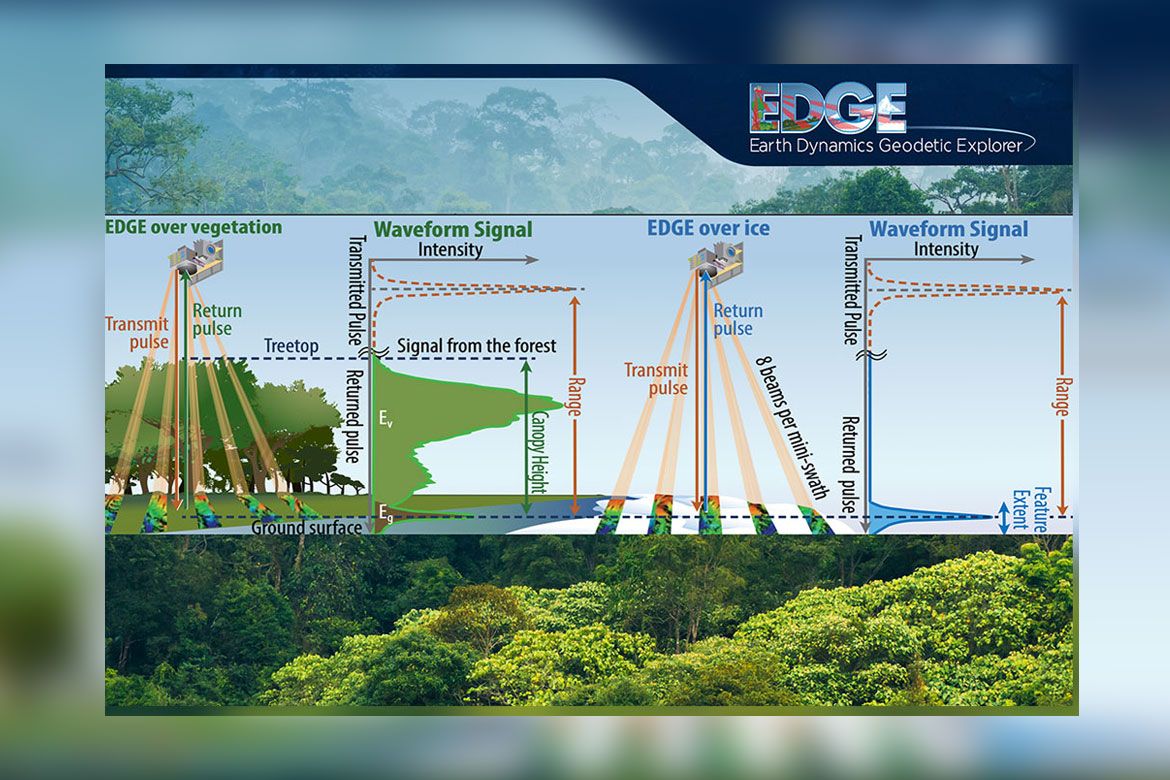
EDGE’s innovation stems from its “mini-swath” approach. With five full-waveform lasers each split into eight beams, it lays down five 120-meter-wide “mini-swaths” that continuously profile the 3D structure of forests and ice features.
<関連情報>
- https://newsroom.ucla.edu/releases/ucla-researcher-nasa-project-satellite-map-earth
- https://www.nature.com/articles/s41597-024-03668-4
GEDIによる植生構造のマルチ解像度グリッドマップ Multi-resolution gridded maps of vegetation structure from GEDI
Patrick Burns,Christopher R. Hakkenberg & Scott J. Goetz
Scientific Data Published:14 August 2024
DOI:https://doi.org/10.1038/s41597-024-03668-4
Abstract
Large-extent maps of three-dimensional vegetation structure are important for understanding the hydrologic cycle, climate, carbon fluxes, and habitat. We aggregated over 7 billion lidar shots from the Global Ecosystem Dynamics Investigation (GEDI) to produce analysis-ready, gridded rasters of 36 vegetation structure metrics at three spatial resolutions (1, 6, and 12 km). We used 8 statistics to grid shots in every pixel, specifically the mean, bootstrapped standard error of the mean, median, standard deviation, interquartile range, Shannon’s Diversity Index, and shot count. We quantified uncertainty of the mean by randomly selecting 100 subsets of shots (i.e. bootstrapping) within each pixel. We also assessed the accuracy of several gridded metrics using fine spatial resolution airborne laser scanning data. The gridded metrics are generally more accurate at mid latitudes due to higher shot density and lower density of vegetation. Statistics associated with the central or maximum tendency of a metric are more accurate than statistics related to variability of metric values within the pixel.