2026-01-22 アメリカ合衆国・ローレンスバークレー国立研究所(LBNL)
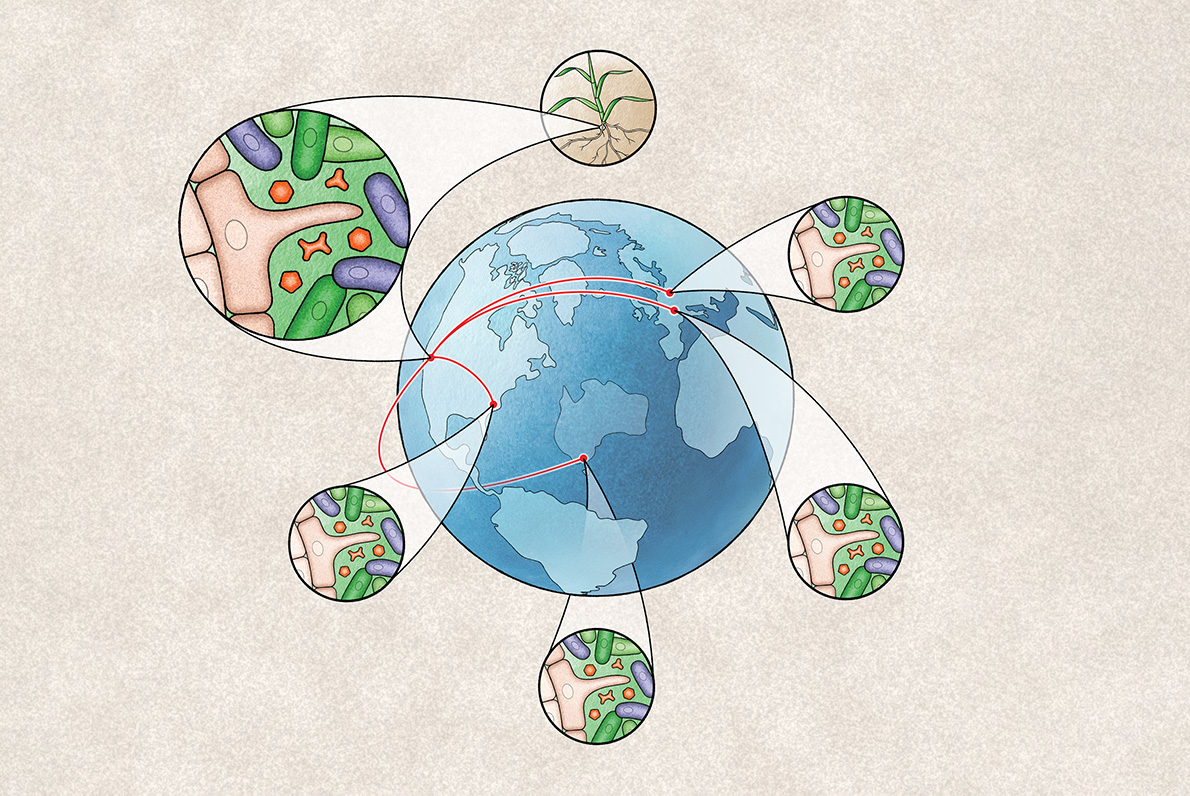
The illustration shows a global centralized network of five laboratories collaborating to study the rhizosphere microbiome and metabolome. (Credit: Kent Leech)
<関連情報>
- https://newscenter.lbl.gov/2026/01/22/ecofabs-could-help-fuel-ai-in-agriculture/
- https://journals.plos.org/plosbiology/article?id=10.1371/journal.pbio.3003358
植物微生物叢研究のための標準化されたプロトコルで再現性の壁を打ち破る Breaking the reproducibility barrier with standardized protocols for plant–microbiome research
Vlastimil Novak,Peter F. Andeer,Eoghan King,Jacob Calabria,Connor Fitzpatrick,Jana M. Kelm,Kathrin Wippel,Suzanne M. Kosina,Benjamin P. Bowen,Chris Daum,Matthew Zane,Archana Yadav,Mingfei Chen, [ … ],Trent R. Northen
PLOS Biology Published: September 8, 2025
DOI:https://doi.org/10.1371/journal.pbio.3003358
Abstract
Inter-laboratory replicability is crucial yet challenging in microbiome research. Leveraging microbiomes to promote soil health and plant growth requires understanding underlying molecular mechanisms using reproducible experimental systems. In a global collaborative effort involving five laboratories, we aimed to help advance reproducibility in microbiome studies by testing our ability to replicate synthetic community assembly experiments. Our study compared fabricated ecosystems constructed using two different synthetic bacterial communities, the model grass Brachypodium distachyon, and sterile EcoFAB 2.0 devices. All participating laboratories observed consistent inoculum-dependent changes in plant phenotype, root exudate composition, and final bacterial community structure, where Paraburkholderia sp. OAS925 could dramatically shift microbiome composition. Comparative genomics and exudate utilization linked the pH-dependent colonization ability of Paraburkholderia, which was further confirmed with motility assays. The study provides detailed protocols, benchmarking datasets, and best practices to help advance replicable science and inform future multi-laboratory reproducibility studies.