2026-03-31 東北大学
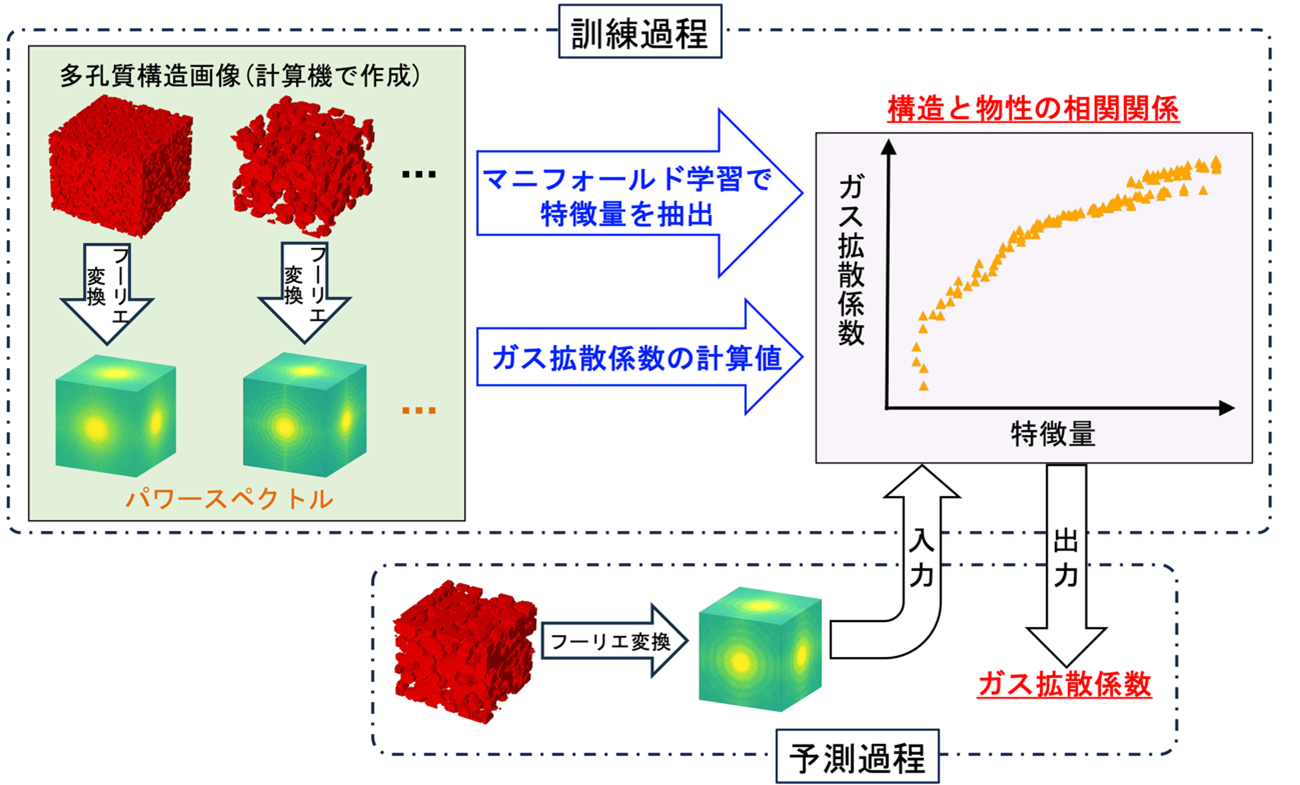
図1. 本研究で提案する構造と物性の相関関係の構築方法と、それを用いた予測方法。
<関連情報>
- https://www.tohoku.ac.jp/japanese/2026/03/press20260331-05-nano.html
- https://www.tohoku.ac.jp/japanese/newimg/pressimg/tohokuuniv-press20260331_05web_nano.pdf
- https://www.sciencedirect.com/science/article/pii/S037877532600666X
多様体学習とX線プティコグラフィーナノコンピュータ断層撮影法によるプロトン交換膜燃料電池触媒層のガス拡散特性の構造ベース予測 Structure-based prediction of gas diffusion property of catalytic layer of proton exchange membrane fuel cells via manifold learning and X-ray ptychographic nano-computed tomography
Shota Arai,Yuki Takayama,Takashi Yoshidome
Journal of Power Sources Available online: 26 March 2026
DOI:https://doi.org/10.1016/j.jpowsour.2026.239916
Highlights
- The relationship between gas diffusion and catalyst layer structure was constructed.
- An effective structural data representation in the manifold learning was proposed.
- Gas-diffusion coefficients were accurately predicted with errors below 10%.
- The relationship was validated by NanoTerasu hard X-ray nano-CT data.
Abstract
Proton-exchange membrane fuel cells (PEMFCs) have attracted significant attention as a promising technology for clean and efficient power conversion, contributing to the realization of a sustainable, carbon-neutral future. To advance this technology, a data-driven framework is proposed to construct structure–property relationships between gas diffusion and the three-dimensional structure of the catalyst layer (CL) within the catalyst-coated membrane of a PEMFC. Our approach uses manifold learning to extract the intrinsic structural features of the CL implicitly, thereby eliminating the need for manual feature engineering. To significantly enhance prediction performance, manifold learning is performed in a high-dimensional space defined by the logarithmic power spectra of the porous structures, which effectively capture features relevant to gas diffusion. The framework accurately predicts gas-diffusion coefficients with relative errors below 10%, even in low-resolution regimes where direct simulations fail. Validated using hard X-ray ptychographic nano-CT data acquired at the NanoTerasu facility, these findings establish a robust foundation for a new paradigm in the data-driven design of materials and devices with complex hierarchical architectures and in the development of digital twins for complex functional materials.