2026-03-27 ワシントン大学(UW)
<関連情報>
- https://www.washington.edu/news/2026/03/27/march-research-highlights-nautilus-habitat-eco-friendly-tennis-courts-more/
- https://royalsocietypublishing.org/rstb/article/381/1946/20250261/480998/Thermal-variability-how-realistic-temperature
Thermal variability: how realistic temperature fluctuations alter physiological performance in intertidal mussels
Michael T. Nishizaki ;Sara Leuchtenberger;Wanying Na;Mo Armstrong
Proceedings of the Royal Society B Published:19 Mar 2026
DOI:https://doi.org/10.1098/rstb.2025.0261
Abstract
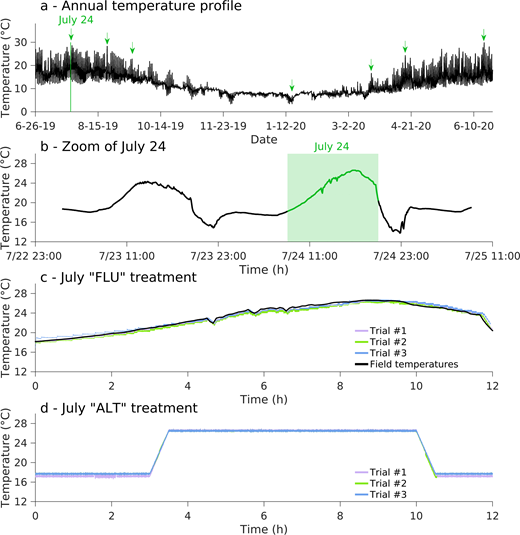
Understanding how fluctuating temperatures impact ectothermic physiological performance is critical for predicting species’ responses to climate change. Many laboratory studies use simplified thermal designs that typically alternate between fixed minimum and maximum temperatures to simulate environmental conditions. However, these designs may not accurately reflect the rate, timing and duration of natural temperature fluctuations. We investigated the effects of two fluctuating temperature regimes on mussel respiration: an alternating treatment that cycled between the daily minimum and maximum temperatures and a field-based treatment constructed from continuous temperature measurements collected from our field site. Using temperature-controlled chambers, we exposed mussels to thermal conditions representing natural seasonal variation and measured oxygen consumption. Nonlinear thermal performance curves (TPCs) were fitted to estimate the optimal temperature (Topt), maximum metabolic rate (Rmax) and critical thermal maximum (CTmax). We found that respiration patterns differed between treatments, and TPC parameter estimates (Rmax, Topt, CTmax) showed non-overlapping bootstrap confidence intervals, indicating treatment-level differences supported by bootstrap inference. These results suggest that thermal performance is strongly influenced by heating rate and exposure duration. Our findings underscore the importance of using ecologically realistic thermal regimes in laboratory studies and have implications for predicting organismal resilience to climate change.