2026-03-23 中国科学院(CAS)
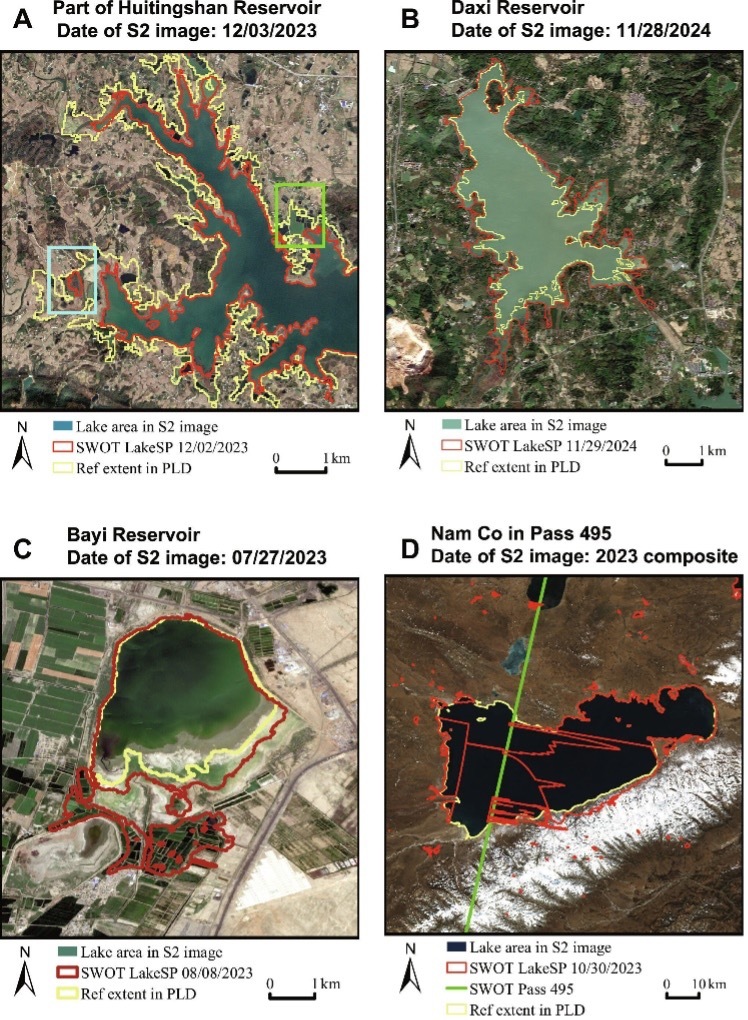
Lake extent derived from SWOT L2 HR LakeSP data compared to Sentinel-2 optical images in case lakes. (Image by AIRCAS)
<関連情報>
- https://english.cas.cn/newsroom/research-news/202603/t20260327_1154061.shtml
- https://spj.science.org/doi/10.34133/remotesensing.1026
SWOT衛星による湖水量モニタリングの性能検証:中国の湖沼を事例とした研究 Exploring the Performance of SWOT Satellite to Monitor Lake Volumes: A Case Study of Chinese Lakes
Ruofan Jing, Jingjuan Liao, Shanmu Ma, Xiangyu Liu, and Yanhong Wu
Journal of Remote Sensing Published:29 Jan 2026
DOI:https://doi.org/10.34133/remotesensing.1026
Abstract
Changes in lake volumes are very important for basin water balance, water resource management, and disaster prevention. Remote sensing technologies, including satellite altimetry, optical, and SAR (synthetic aperture radar) remote sensing, can monitor lake volume changes in real time. However, current methods face challenges such as inconsistent time resolution, satellite transit times, and difficulty monitoring small lakes. The Surface Water and Ocean Topography (SWOT) satellite, launched in December 2022, carries the Ka-band interferometer KaRIn, which is capable of wide-swath altimetry and water detection, providing synchronous lake levels and lake areas, and is expected to monitor about 65% of changes in the total lake volume. It is therefore necessary to explore the potential of officially released SWOT data in practical applications. In this study, we estimate the lake volumes in China based on the latest SWOT Lake Product during 2023–2024, assesses the application potential of SWOT data, and combines multi-source bathymetry data to analyze the variations of lake volumes. The results showed that SWOT data greatly improved the ability to monitor small lakes, and the estimated water volume changes had a high accuracy, with errors of within 10% for the validation reservoirs, reaching a minimum of 3.92%. We also suggest that SWOT-observed lake areas tend to be overestimated compared to existing high-accuracy datasets. Within the study area, lake volume exhibited an upward trend and obvious seasonal variations were observed in some regions. Approximately 85% of the changes originate from natural lakes, and large lakes are the main source of the increase. With future updates to SWOT data versions and advancements in data processing methods, the accuracy and coverage of lake volume monitoring are expected to improve further.