2026-03-27 東京科学大学
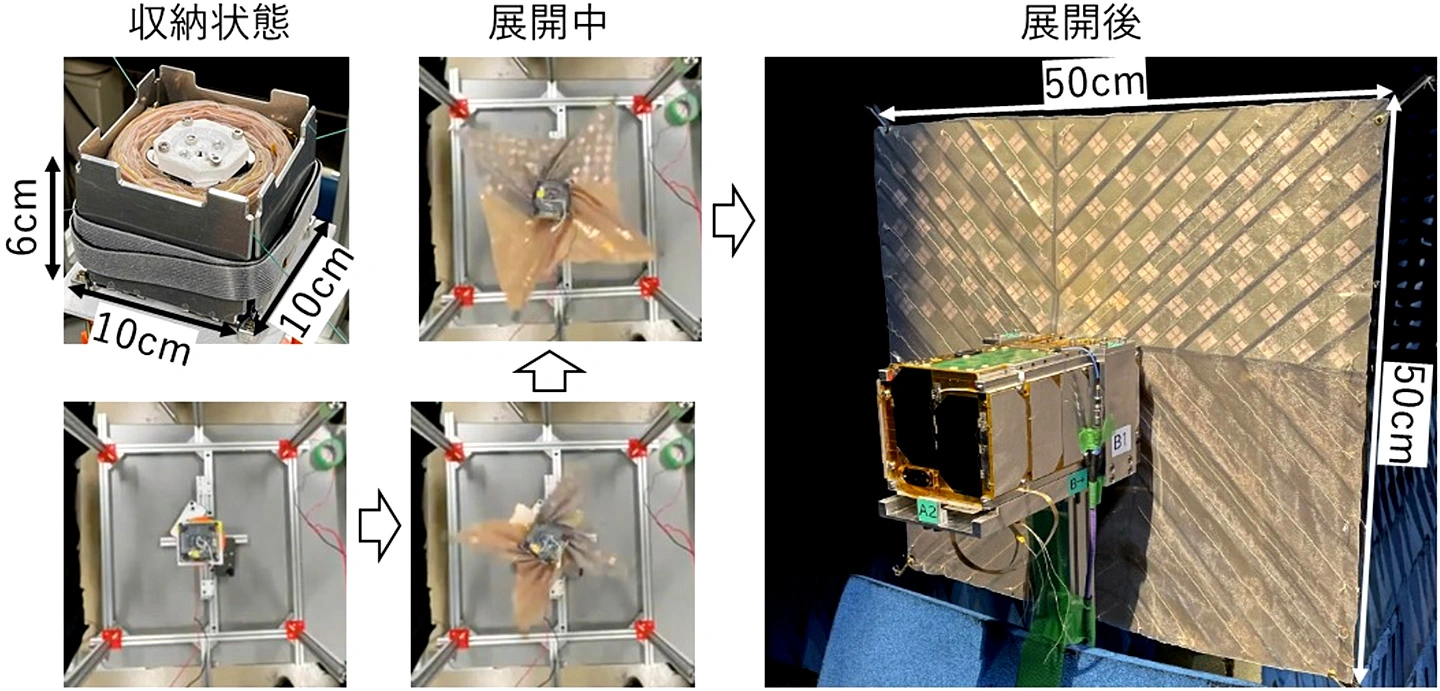
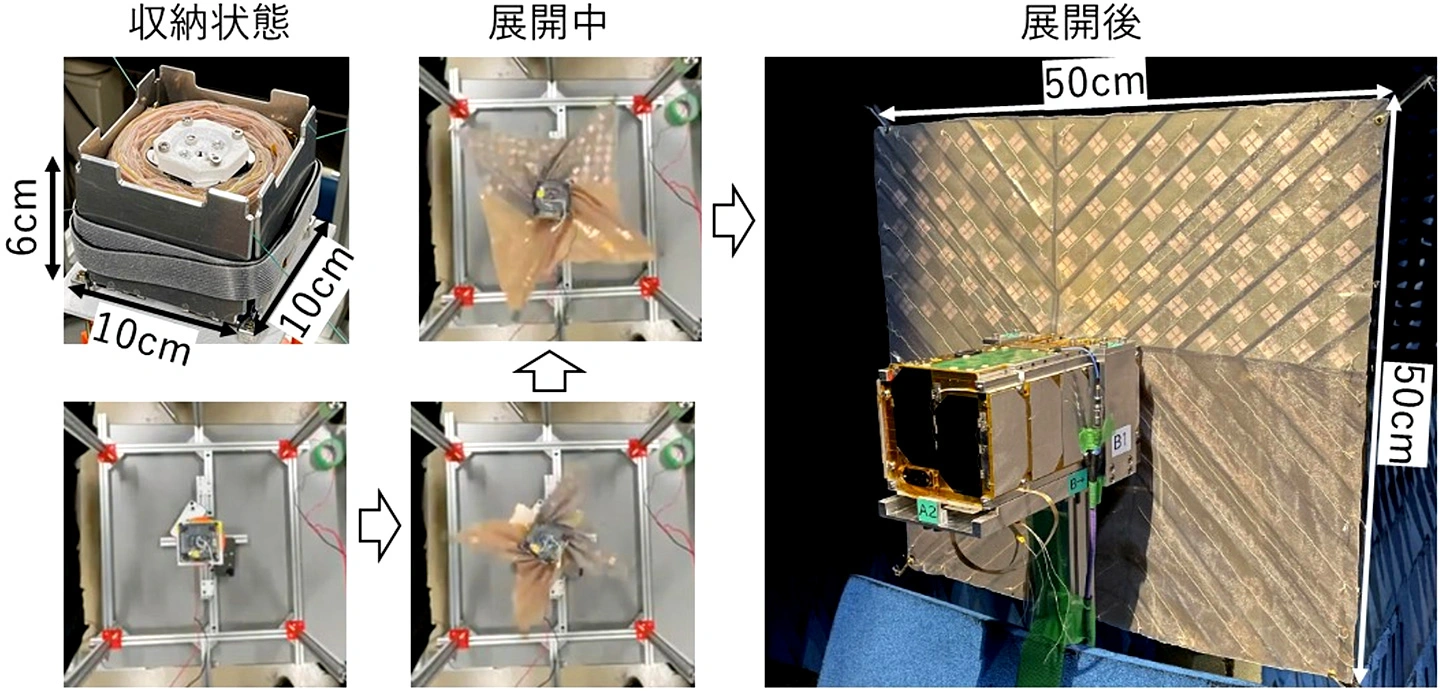
図1. 超小型衛星搭載用の折り紙展開リフレクトアレーアンテナ
<関連情報>
CubeSat向け5.8GHz帯折り紙展開式反射アレイアンテナ A 5.8-GHz-Band Origami Deployable Reflectarray Antenna for CubeSats
Kodai Suzuki; Haruki Kurokawa; Gen Nakayama; Mitsuhiko Yasuhara; Atsuki Ochi; Suk So Yeon,…
IEEE Transactions on Antennas and Propagation Published:27 January 2026
DOI:https://doi.org/10.1109/TAP.2026.3656735
Abstract
This paper proposes a linearly to circularly polarized conversion membrane deployable reflectarray antenna for CubeSat with a beam-tilting primary radiator for small satellites. The use of a large number of small satellites is attracting attention for the realization of advanced space applications. These satellites require small, lightweight, and large antennas. This paper aims to design a deployable reflectarray antenna with a membrane expansion structure that satisfies these requirements. The beam-tilting primary radiator is designed to reduce gain loss due to blocking. A reflectarray element capable of converting the linearly polarized wave from the primary radiator to a circularly polarized wave was also designed to enable to radiate circular polarization. For the primary radiator, a large tilt angle was achieved by using a one-side shorted patch element. The membrane deployment structure achieves a storage ratio of 265%, and the total weight, including the support structure for deployment, is only 64 g, making it lightweight. The reflectarray element has a square patch structure with I-shaped cross-slots. A circularly polarized reflection phase of 280 deg. was achieved for linearly polarized wave incidence. The overall structure of the reflect array achieved an antenna gain of 20.3 dBi and an axial ratio of 1.8 dB, as analyzed, and an antenna gain of 18.0 dBi and an axial ratio of 1.4 dB, as measured, including the satellite chassis.