2026-03-17 中国科学院(CAS)
<関連情報>
- https://english.cas.cn/newsroom/cas-in-media/202603/t20260317_1152806.shtml
- https://iopscience.iop.org/article/10.1088/1674-4527/ae3b2d
メインベルトからの天問2号ミッションによる(469219)カモオアレワの力学的起源:ν 6永年共鳴、フローラファミリーまたは木星との3:1共鳴 Dynamical Origin of (469219) Kamo‘oalewa of Tianwen-2 Mission from the Main Belt: ν6 Secular Resonance, Flora Family or 3:1 Resonance with Jupiter
Yandong Wang, Shoucun Hu, Jianghui Ji and Jiajun Ying
Research Astronomy Astrophysics Published: 10 February 2026
DOI:10.1088/1674-4527/ae3b2d
Abstract
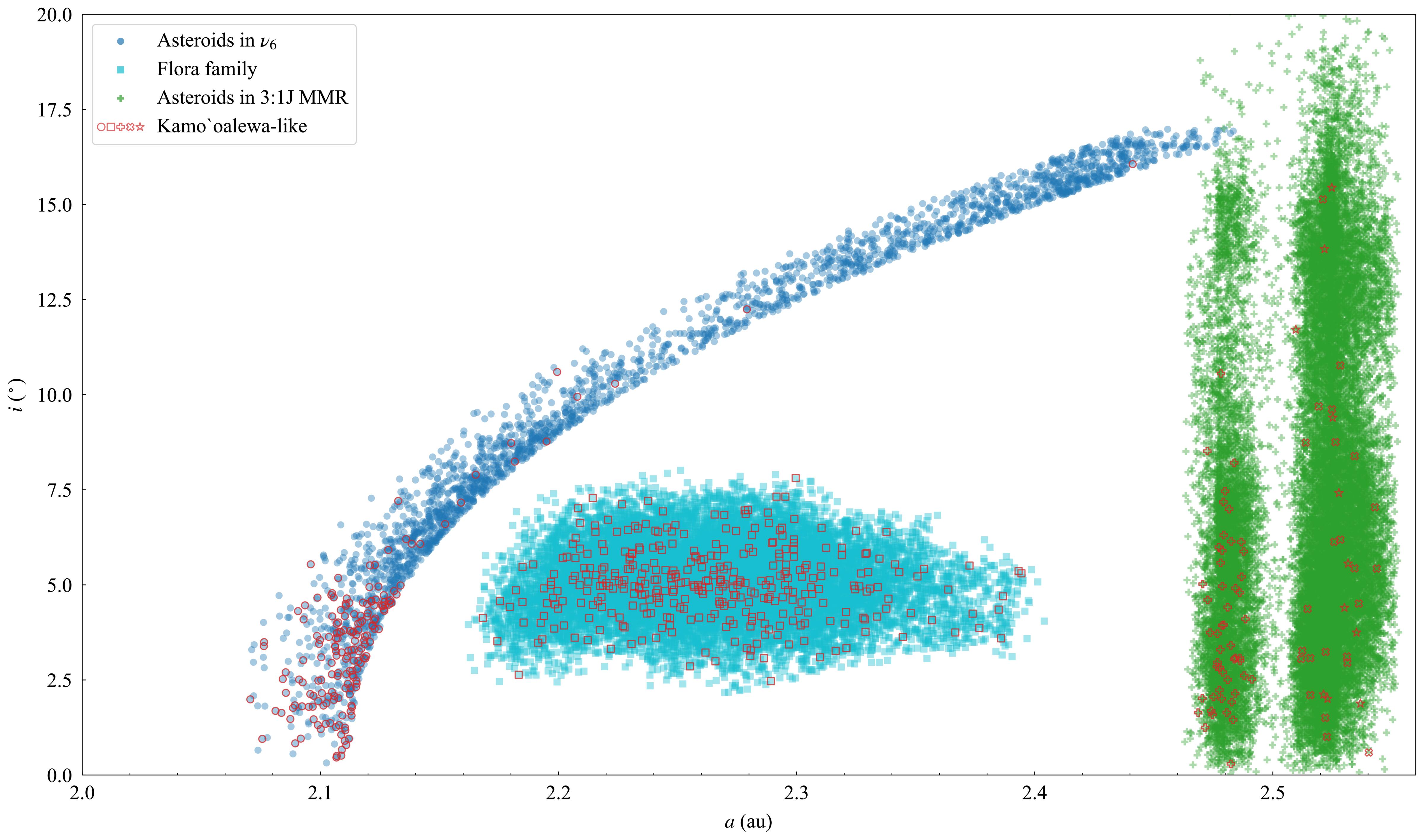
China’s Tianwen-2 mission, launched on 2025 May 29, targets the near-Earth object (NEO) (469219) Kamo‘oalewa, an Earth quasi-satellite trapped in a 1:1 mean-motion resonance with our planet. Determining the origin of Kamo‘oalewa is central to understanding the formation pathways and dynamical evolution of Earth’s quasi-satellite population. Here we show a strong possibility of main-belt origin for Kamo‘oalewa using long-term dynamical simulations. We examine three candidate source regions: the ν6 secular resonance (ν6), the 3:1 mean-motion resonance with Jupiter (3:1J MMR), and the Flora family. A total of 42,825 test particles were integrated over 100 Myr. We find that asteroids from all three regions can be transported onto Kamo‘oalewa-like orbits, albeit with markedly different efficiencies. Particles originating near the ν6 show the highest transfer probability (3.31%), followed by the Flora family (2.54%) and the 3:1J MMR (0.39%). We further identify representative dynamical pathways linking these source regions to Kamo‘oalewa-like orbits. The Tianwen-2 spacecraft is expected to rendezvous with Kamo‘oalewa in 2026, performing close-proximity operations and returning samples. The mission will provide decisive observational constraints on the asteroid’s composition and physical properties, offering a critical test of its proposed origin.