2026-03-10 中国科学院(CAS)
<関連情報>
- https://english.cas.cn/newsroom/research-news/202603/t20260313_1152680.shtml
- https://iopscience.iop.org/article/10.3847/1538-4357/ae30db
測光および分光連続残響マッピングによるNGC 4151における光度依存性連続光遅延の発見 Discovery of a Luminosity-dependent Continuum Lag in NGC 4151 from Photometric and Spectroscopic Continuum Reverberation Mapping
Hai-Cheng Feng, Sha-Sha Li, Mouyuan Sun, Ciro Pinto, Shuying Zhou, Yerong Xu, J. M. Bai, Elena Dalla Bontà, ZhongNan Dong, Neeraj Kumari,…
The Astrophysical Journal Published: 2026 January 29
DOI:10.3847/1538-4357/ae30db
Abstract
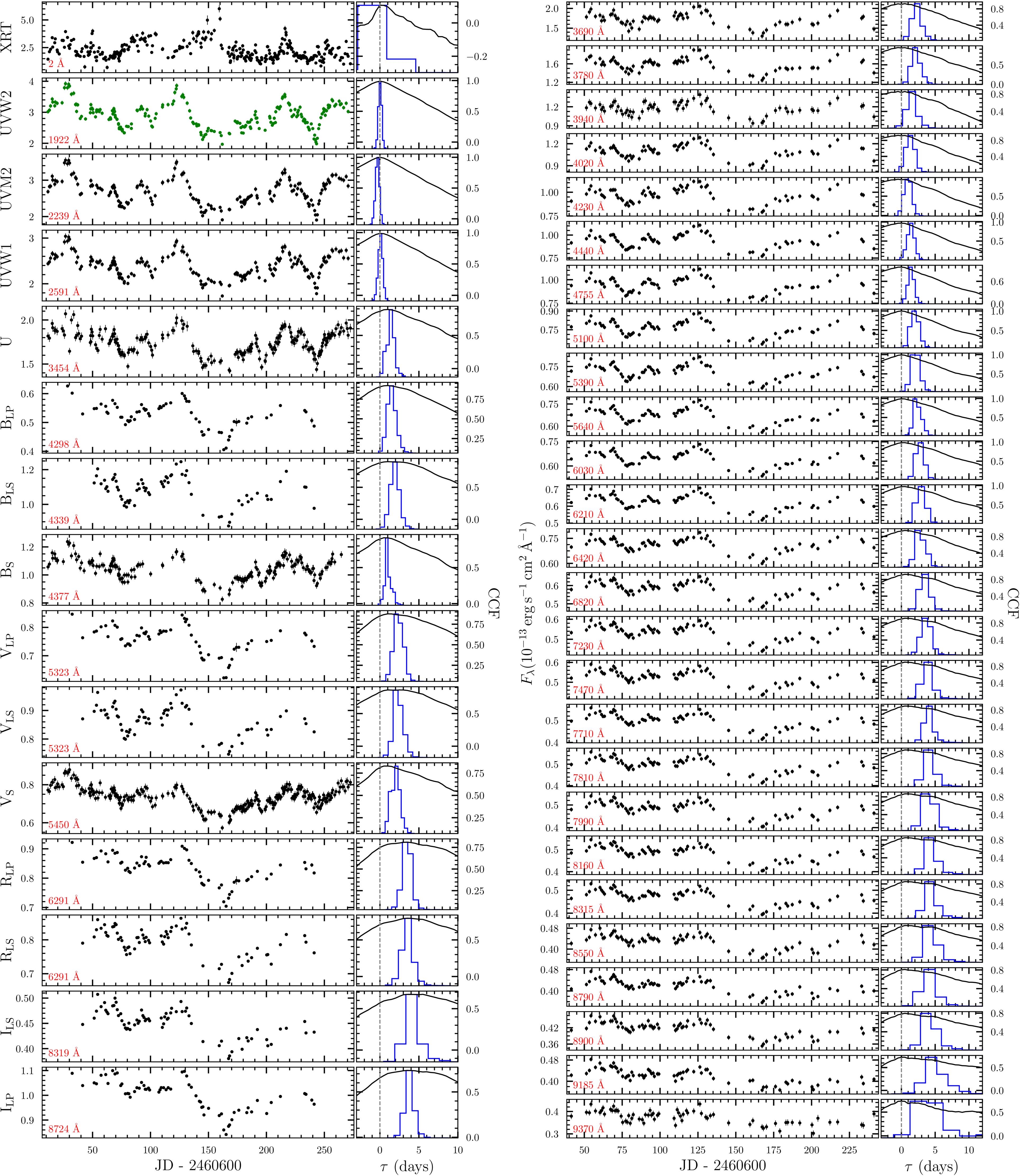
Accretion onto supermassive black holes (SMBHs) powers active galactic nuclei (AGNs) and drives feedback that shapes galaxy evolution. Constraining AGN accretion disk structure is therefore essential for understanding black hole growth and feedback processes. However, direct constraints on disk size remain rare—particularly from long-term, multiseason spectroscopic reverberation mapping (RM), which is critical for isolating the intrinsic disk response from the broad-line region (BLR). We present results from an intensive multiwavelength RM campaign of NGC 4151 during its brightest state in nearly two decades. This represents the third high-cadence monitoring over the past decade, capturing accretion states spanning the transitional regime between thin and thick disks, making NGC 4151 the only AGN with continuum RM observations across such a wide range in accretion states. Combining spectroscopy from the Lijiang 2.4 m telescope with coordinated Swift UV/X-ray monitoring, we measure interband continuum lags from UV to optical. The wavelength-dependent lags follow a tight τ ∝ λ4/3 relation, consistent with reprocessing in a thin disk, but exceed theoretical predictions by a factor of 6.6. Our lag spectrum reveals clear excesses near the Balmer and possibly Paschen jumps, confirming diffuse continuum (DC) contamination from the BLR. By comparing the three campaigns, we discover a nonmonotonic lag–luminosity trend (>3σ), which cannot be explained by DC emission alone. We propose that the lags reflect combined disk and BLR contributions, and present the first evidence that the DC component follows an intrinsic Baldwin effect. These results offer new insights into SMBH mass measurements and theoretical models of AGN inner structure.