2026-03-04 産業技術総合研究所
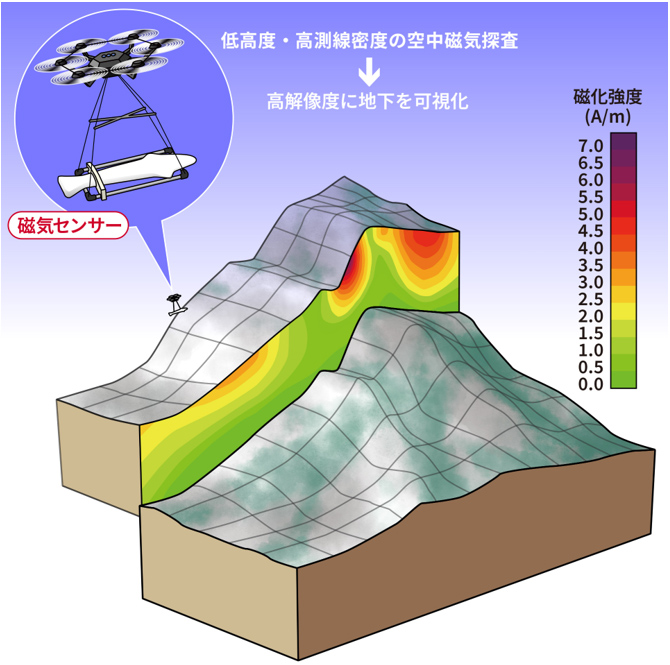
※一部に原論文のデータを使用して作図しています。
<関連情報>
- https://www.aist.go.jp/aist_j/press_release/pr2026/pr20260304/pr20260304.html
- https://link.springer.com/article/10.1186/s40645-026-00800-3
地すべりに関連する熱水変質帯を検出するためのUAVを用いた磁気探査:阿蘇火山における事例研究 UAV-based magnetic survey for detecting hydrothermal alteration zones relevant to landslides: A case study at Aso Volcano, Japan
Shigeo Okuma,Ayumu Miyakawa,Hikari Yonekura,Keiichi Sakaguchi,Hideo Hoshizumi,Tomoya Abe,Daisaku Kawabata,Yoshinori Miyachi & Nobuo Matsushima
Progress in Earth and Planetary Science Published:04 March 2026
DOI:https://doi.org/10.1186/s40645-026-00800-3
Abstract
We combined a regional aeromagnetic survey with an uncrewed aerial vehicle (UAV; drone)-based magnetic survey to map low-magnetization zones associated with intensive hydrothermal activity on the western flank of the central cones of Aso Volcano, Kyushu, Japan. Three-dimensional (3D) magnetic inversion of regional helicopter-borne data shows that the major fumarole and hot-spring areas: Yunotani, Yoshioka, and Jigoku–Tarutama, are characterized by magnetization lows. These lows coincide with mapped surface hydrothermal alteration zones (e.g., kaolinite and smectite zones). To resolve the shallow structure in greater detail, we conducted an ultra-high-resolution UAV-based magnetic survey over the Yoshioka geothermal area. The 3D magnetic inversion of these data reveal detailed magnetization lows (≤ 0.5 A/m) within the horseshoe-shaped valley, localized in upstream geothermal zones on the Yoshioka Lava surface and extending throughout the valley at depths of ≥ 50 m. Rock magnetic measurements show that the magnetization of the Yoshioka Lavas decreases systematically with the degree of alteration. Microscopic analyses confirm the presence of alteration minerals, indicating that low-magnetization volumes identified by magnetic inversion correspond to hydrothermally altered zones. A major landslide triggered by torrential rainfall in 2012 occurred in a valley near the most upstream geothermal area. Strong magnetization highs were detected on the cliffs of the plateau behind the valley and correspond to the welded sections of the Kusasenrigahama pumice fall deposits (Kpfa). However, localized magnetization lows along the plateau edge coincide with multiple source areas of landslides triggered by the 2016 Kumamoto Earthquake and with associated fissure alignments. Notably, obvious magnetization lows beneath the plateau edge suggest subsurface hydrothermal activity, as supported by geological evidence.