2026-03-02 中国科学院(CAS)
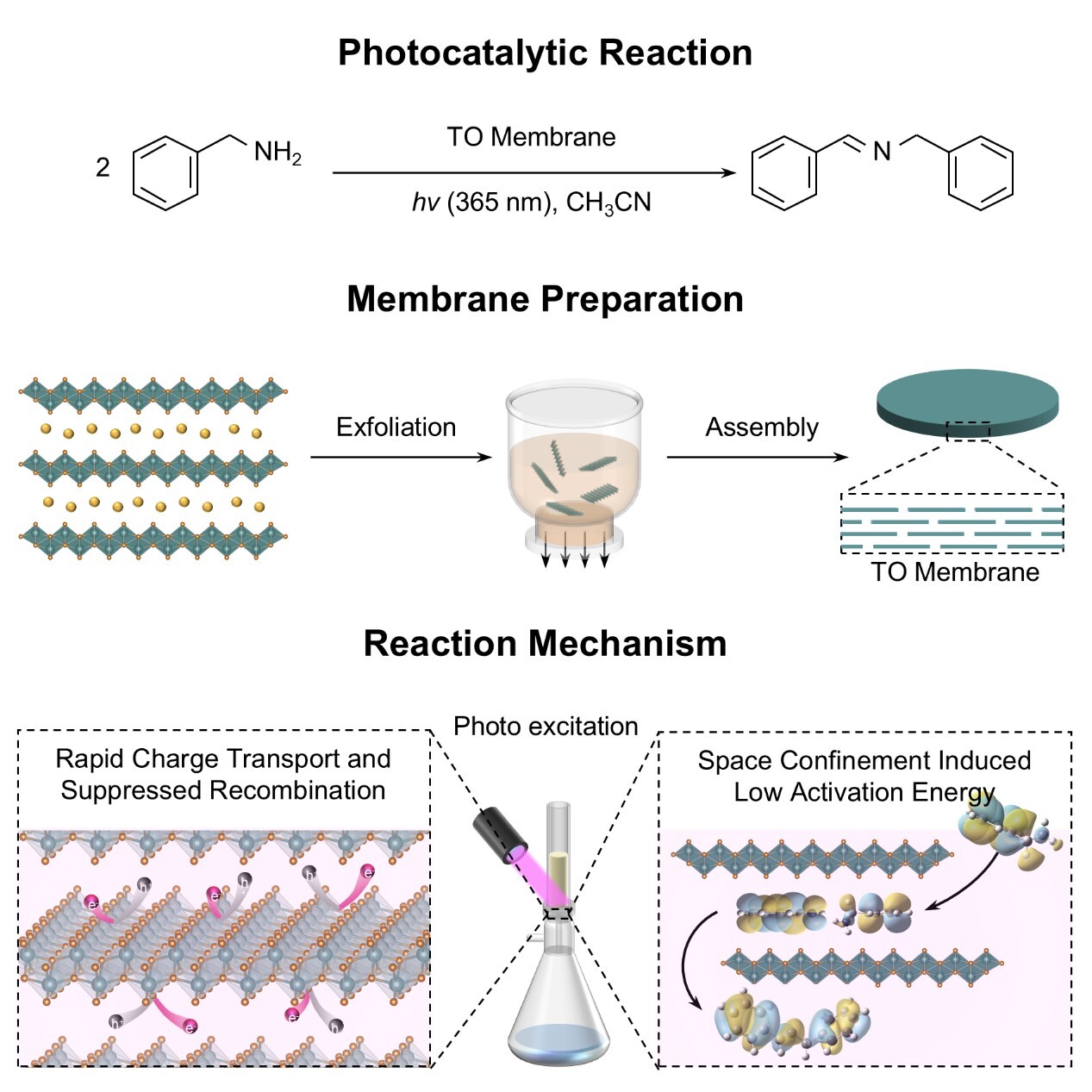
Schematic illustration of the membrane reactor for photocatalytic synthesis. (Image by ZHANG’s Group)
<関連情報>
- https://english.cas.cn/newsroom/research-news/202603/t20260302_1151340.shtml
- https://www.cell.com/matter/abstract/S2590-2385(25)00672-1
効率的なオングストローム制限流光触媒のための2D酸化チタン膜 2D titanium oxide membranes for efficient angstrom-confined flow photocatalysis
Guandi He ∙ Jiahui Zhao∙ Rui Luo ∙ … ∙ Daoling Peng ∙ Xiqi Zhang ∙ Lei Jiang
Matter Published:February 18, 2026
DOI:https://doi.org/10.1016/j.matt.2025.102629
Progress and potential
Inspired by enzymes, nanoconfined catalysis has emerged as a crucial means to enhance the performance of numerous chemical processes. However, the influence of the confinement effect on two-dimensional photocatalytic systems remains to be explored. Herein, we prepared multilayer titanium oxide membranes for efficient photocatalytic benzylamine coupling reaction with directional flow. Optimal performance was achieved to reach 99.2% conversion and 99.3% selectivity within 7 s at room temperature. We envision that the developed photocatalytic reactor can provide a new green pathway for the efficient flow synthesis of organic molecules.
Highlights
- Membrane nanoreactors for efficient photocatalytic benzylamine coupling reaction
- Optimal performance can achieve complete benzylamine transformation within 7 s
- The formation of the membranes enhances charge separation and transfer
- Spatial confinement and metal vacancies promote the overall reaction
Summary
Enzymatic spatial confinement is crucial for efficient catalysis. Inspired by enzymes, nanoconfined catalysis enhances the performance of numerous chemical processes. However, the impact of confinement effect on two-dimensional photocatalytic systems remains unexplored. Herein, we prepared multilayer titanium oxide (TO) membranes for efficient photocatalytic benzylamine coupling reaction under directional flow. By modulating interlayer spacing, incident light intensity, and membrane thickness, we achieved optimal performance, resulting in 99.2% conversion and 99.3% selectivity within 7 s at room temperature, outperforming both bulk reactions catalyzed by TO nanosheets and surface-catalyzed reactions by TO membrane. Mechanism studies elucidate that the formation of TO membranes enhances the efficiency of charge separation and transfer. The synergy between spatial confinement and metal vacancies promotes reactant adsorption and reduces the reaction energy barrier. This method also applies to various benzylamine derivatives. We envision this photocatalytic reactor offering a new green pathway for efficient flow synthesis of organic molecules.