2026-02-26 中国科学院(CAS)
<関連情報>
- https://english.cas.cn/newsroom/research-news/202602/t20260226_1151206.shtml
- https://www.nature.com/articles/s41560-026-01987-x
ケステライト太陽電池におけるLi2SnS3界面を介して粒成長を制御し、認証効率が15%を超える Regulating grain growth via Li2SnS3 interphase in kesterite solar cells with certified efficiencies exceeding 15%
Changcheng Cui,Yimeng Li,Hao Wei,Xiaofan Du,Zhipeng Shao,Dongxing Kou,Zucheng Wu,Shengren Xia,Xiaopeng Feng,Shuping Pang,Xiao Wang,Sui Mao,Hao Xin,Sixin Wu & Guanglei Cui
Nature Energy Published:25 February 2026
DOI:https://doi.org/10.1038/s41560-026-01987-x
Abstract
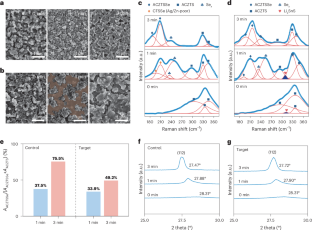
The selenization reaction process is the key step in determining the quality of Cu2ZnSn(S,Se)4 thin films. Imbalanced migration kinetics of metal ions during selenization led to high concentrations of deep-level defects, resulting in dramatic open-circuit voltage loss. In this work, we reported a Li2SnS3 interphase strategy to modify cation migration paths and balance Zn2+/Sn4+ migration differences. The Li2SnS3 interphase selectively encapsulates the Cu2Sn(S,Se)3 intermediate grains, serving as the rate-determining layer for ion migration. The Zn2+/Sn4+ migration barrier difference in the interphase decreases from 0.41 eV in Cu2Sn(S,Se)3 to 0.21 eV in Li2SnS3, which promotes the formation of larger, uniform, high-crystallinity grains. As a result, device efficiency improves from 13.86% to 15.45% (certified at 15.04%), and open-circuit voltage reaches 602 mV at a bandgap of 1.10 eV.