2026-02-03 中国科学院(CAS)
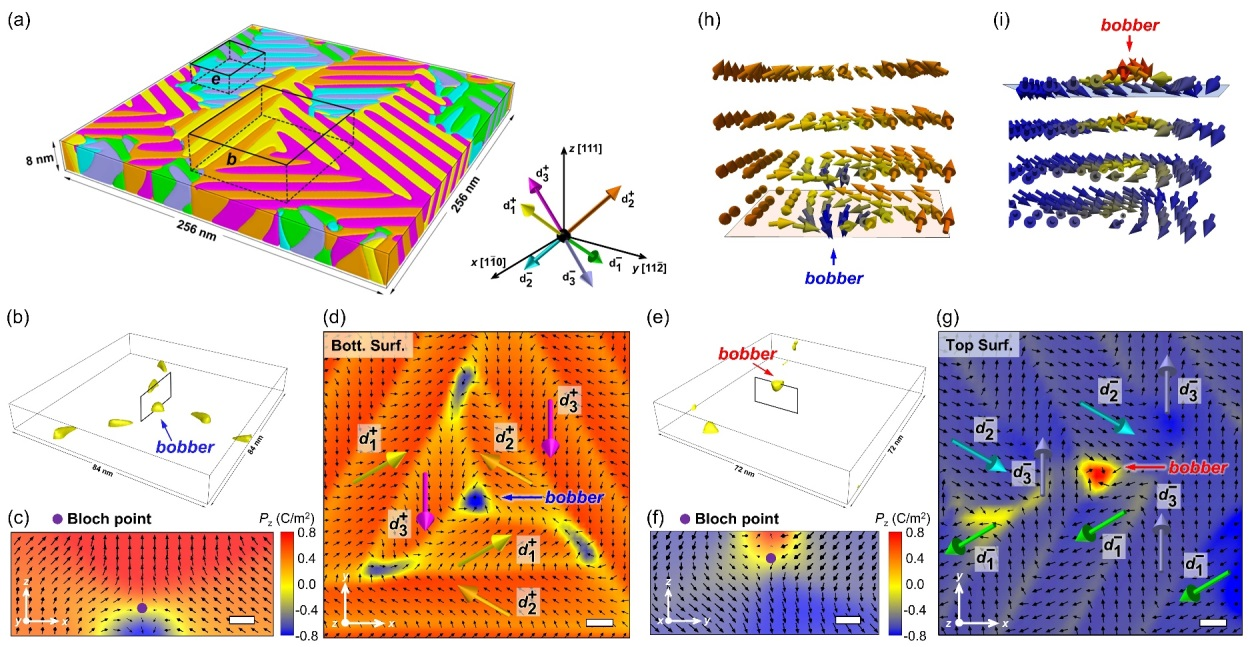
Phase-field simulation predicts the emergence of polar chiral bobbers in (111)-oriented ultrathin PbTiO₃ ferroelectric films and reveals their polarization characteristics. (Image by IMR)
<関連情報>
- https://english.cas.cn/newsroom/research-news/202602/t20260210_1150420.shtml
- https://advanced.onlinelibrary.wiley.com/doi/10.1002/adma.202510518
酸化物強誘電体における多状態極性カイラルボバー Multistate Polar Chiral Bobbers in Oxide Ferroelectrics
Xiang-Wei Guo, Min-Jie Zou, Yun-Long Tang, Yin-Lian Zhu, Yu-Jia Wang, Xiu-Liang Ma
Advanced Materials Published: 30 January 2026
DOI:https://doi.org/10.1002/adma.202510518
ABSTRACT
Polar topologies in ferroelectric oxides have potential applications in future electronic devices, such as high-density non-volatile memory and logic devices. However, their application in multistate storage remains largely unexplored, because the number of accessible topological states is limited. Here, we report a family of polar chiral bobbers in ultrathin (111)-oriented ferroelectric PbTiO3 films by combining phase-field simulations with aberration-corrected transmission electron microscopy. We find that a chiral bobber can exhibit eight distinct states, which can be applied to multistate storage exceeding the traditional binary (0/1) encoding. The polar chiral bobber can be easily manipulated with low energy to enable transitions between different states. These results suggest that polar chiral bobbers represent one of the promising candidates for applications in next-generation topological electronics, advanced memory, and quantum computing.