2026-02-06 東北大学
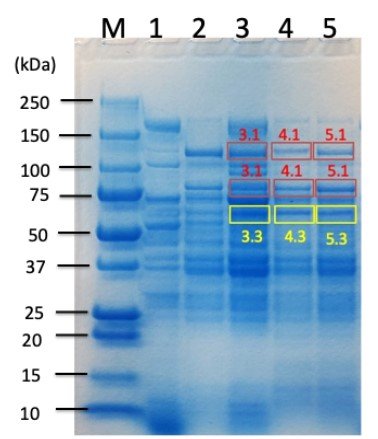
図1.SDSゲル電気泳動による C. cellulovorans (C.c) 培養上清中の分泌たんぱく質の解析
<関連情報>
- https://www.tohoku.ac.jp/japanese/2026/02/press202602026-04-sorghum.html
- https://www.tohoku.ac.jp/japanese/newimg/pressimg/tohokuuniv-pres20260206_04_sorghum.pdf
- https://www.mdpi.com/1422-0067/26/23/11728
ソルガムバガスを用いたClostridium cellulovoransのセルロソームおよび非セルロソーム酵素のプロテオーム特性評価 Proteomic Characterization of the Clostridium cellulovorans Cellulosome and Noncellulosomal Enzymes with Sorghum Bagasse
Mohamed Y. Eljonid, Fumiyoshi Okazaki, Eiji Hishinuma,, Naomi Matsukawa, Sahar Hamido and Yutaka Tamaru
International Journal of Molecular Sciences Published:3 December 2025
DOI:https://doi.org/10.3390/ijms262311728
Abstract
Sorghum, the fifth major global cereal, has potential as a source crop in temperate regions. To completely use sorghum bagasse, the ideal enzyme cocktail aims to identify and select the contributed enzymatic system. This study investigated the enzymatic system of Clostridium cellulovorans cellulosome and noncellulosomal enzymes using sodium dodecyl sulfate polyacrylamide gel electrophoresis (SDS-PAGE) and liquid chromatography–tandem mass spectrometry LC-MS/MS. Enzyme solutions from treated and untreated sorghum bagasse were prepared and compared based on carboxymethyl cellulase (CMCase) activity. As a result, the enzyme solution derived from untreated sorghum bagasse had the highest activity. Protein bands from each C. cellulovorans culture showed distinct patterns on SDS-PAGE examination: three enzyme fractions, including culture supernatants, crystalline cellulose (Avicel) bound, and unbound fractions. These results suggested that untreated sorghum bagasse induced a variety of cellulosomal and uncellulosomal proteins. On the other hand, 5% or 10% sorghum supernatants could not induce Avicel-bound proteins, including the cellulosome, although even 5% sorghum juice induced three major bands: 180 kilodalton (kDa), 100 kDa, and 70 kDa, respectively. In contrast, cellobiose induced three major bands, while the total number of all isolated proteins from the cellobiose medium was the most limited among all culture media. More intriguingly, our investigation detected one cellulosomal protein, hydrophobic protein A (HbpA) and three noncellulosomal enzymes, indicating that glycosyl hydrolase family 130 (GH130) was identified as a biomass-induced enzyme in good accord with previously published proteomic studies. Therefore, the proteomic dataset generated in this study provides us a foundation for future computational approaches, including machine learning-based prediction of optimal enzyme cocktails for target biomass degradation.