2026-01-30 東北大学
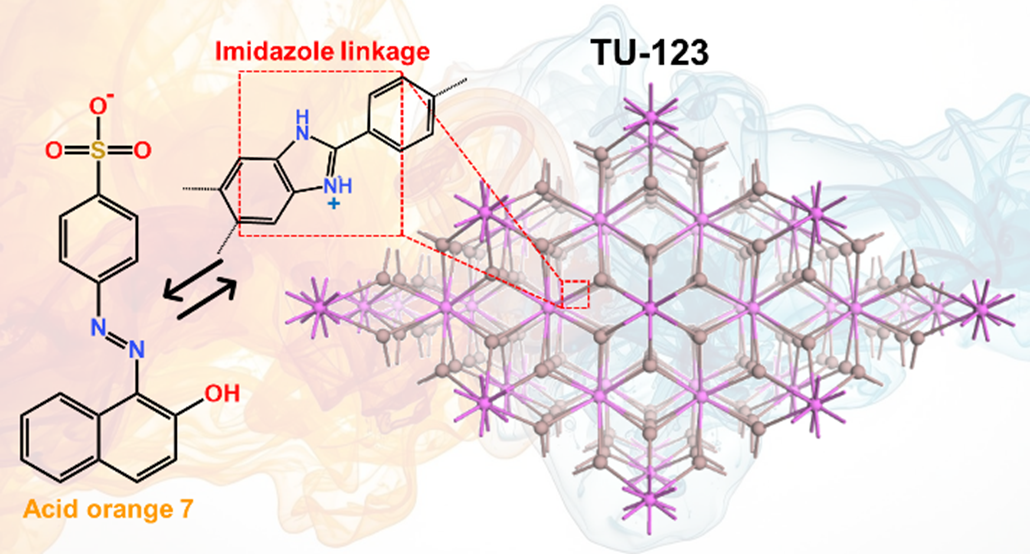
図1. イミダゾール結合型高連結三次元COF TU-123を用いた、アニオン性染料分子吸着の概念図。TU-123は中性条件下で表面が正に帯電する(カチオン性)ため、アシッドオレンジ7などの負に帯電する(アニオン性)染料分子を静電相互作用により引き寄せます
<関連情報>
- https://www.tohoku.ac.jp/japanese/2026/01/press20260130-01-COF.html
- https://www.tohoku.ac.jp/japanese/newimg/pressimg/tohokuuniv-press20260130_01web_COF.pdf
- https://pubs.acs.org/doi/10.1021/jacs.5c19590
多成分デブス・ラジシェフスキ経路を超えて:二成分環化縮合 12 + 3 連結 aea トポロジーの構築 持続可能な廃水処理のための三次元イミダゾール結合 COF Beyond the Multicomponent Debus–Radziszewski Route: Two-Component Cyclocondensation Constructing a 12 + 3-Connected aea Topology Three-Dimensional Imidazole-Linked COF for Sustainable Wastewater Treatment
Tsukasa Irie,Kohki Sasaki,Mika Nozaki,Tokuhisa Kawawaki,Saikat Das,and Yuichi Negishi
Journal of the American Chemistry Society Published: January 23, 2026
DOI:https://doi.org/10.1021/jacs.5c19590
Abstract
The rational construction of high-connectivity three-dimensional covalent organic frameworks (3D COFs) remains a central challenge in reticular chemistry, holding immense promise for advancing framework rigidity, porosity, and functional integration. From both fundamental and application standpoints, diversifying the linkage chemistry of such high-connectivity COFs beyond the archetypal imine bond is essential, as imidazole linkages impart superior chemical resilience, enhanced π-delocalization, and intrinsic polarity compared with imine linkages. Here, we report TU-123, the first 12 + 3-connected 3D imidazole-linked COF with aea topology, synthesized via a two-component cyclocondensation between a D3-symmetric hexakis-aldehyde and a D3h-symmetric hexaamine building block. Unlike conventional imidazole-linked COFs derived from multicomponent Debus–Radziszewski reactions, TU-123 forms through direct imidazole ring formation from aldehyde and amine precursors via an imine intermediate, intramolecular cyclization, and oxidative aromatization. This strategy, previously limited to 2D frameworks, is extended herein to a highly connected 3D network for the first time. Benefiting from its rigid and polarized imidazole framework, TU-123 exhibits a cationic surface character at neutral pH, arising from protonation of nitrogen sites within the imidazole linkages, which enables selective adsorption of anionic dyes such as acid orange 7, with a maximum adsorption capacity of 495.07 mg g–1 and 86.08% removal efficiency under optimized conditions. The adsorption process follows pseudo-second-order kinetics and Langmuir isotherm behavior, highlighting the framework’s potential for sustainable wastewater purification.