
2026-01-07 中国科学院(CAS)
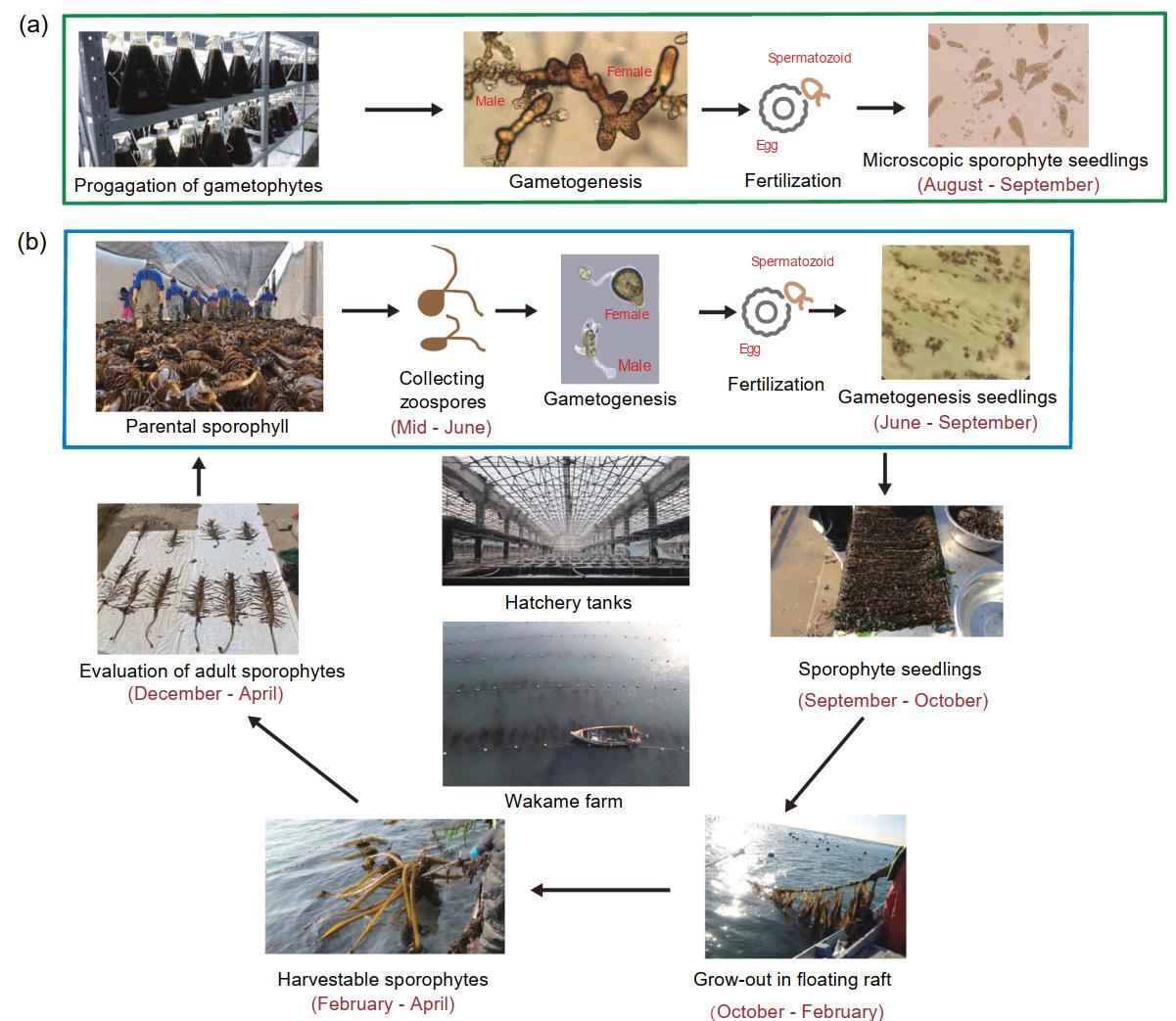
Full stage-covered U. pinnatifida seeldings and cultivation production cycle in north China. (a) Clonal hybrid breeding; (b) Traditional commercial cultivation sporophyte breeding. (Image by IOCAS)
<関連情報>
- https://english.cas.cn/newsroom/research-news/202602/t20260210_1150325.shtml
- https://www.sciencedirect.com/science/article/pii/S2352513425007197
亜熱帯海域におけるクローン種苗を用いた昆布Undaria pinnatifidaの養殖:中国におけるパイロットスタディ Culture of the kelp Undaria pinnatifida in subtropical waters using clonal seedlings: A pilot study in China
Xiaodong Li (李晓东), Mengyun Chen (陈梦云), Mingyong Lai (赖铭勇), Gaoxiong Zeng (曾高雄), Lingzhan Xue (薛凌展), Chenhui Zhong (钟晨辉), Feng Han (韩枫), Xiaofei Leng (冷晓飞), Yaning Yang (杨亚宁), Shaojun Pang (逄少军)
Aquaculture Reports Available online: 6 January 2026
DOI:https://doi.org/10.1016/j.aqrep.2025.103333
Highlights
- Clonal seedlings enabled successful cultivation of U. pinnatifida in subtropical Fujian.
- Undaria sporophytes showed rapid winter growth and commercial-grade biochemical quality.
- Findings support southward expansion of the temperate kelp aquaculture.
Abstract
The temperate-water kelp Undaria pinnatifida (wakame) was successfully farmed in subtropical coastal waters of Fujian, China using clonal sporophyte seedlings. The clonal sporophytes acclimated effectively to subtropical conditions, achieving mean frond lengths of 190.7 ± 18.4 cm and fresh weights of 353.4 ± 58.5 g per individual sporophyte in early March. Cluster-clipping cultivation method yielded 10.20 ± 0.43 kg m⁻¹ cultivation rope, surpassing the traditional northern cultivation counterpart Liaoning province (8.63 ± 0.27 kg m⁻¹) by 19 % and demonstrating 101 % greater biomass than individual-clipping method (5.07 ± 0.25 kg m⁻¹). The subtropical-grown Undaria blades had higher protein content (2.08 ± 0.06 %) and umami-associated amino acid levels (glutamate: 2.46 ± 0.07 g kg⁻¹; aspartate: 1.97 ± 0.06 g kg⁻¹) than blades grown in Liaoning. The success of this subtropical cultivation trial shows the feasibility of expanding the cultivation further down to the southern province to meet the uprising market demands.

