
2025-12-17 NASA
<関連情報>
- https://www.nasa.gov/solar-system/planets/saturn/saturn-moons/titan/nasa-study-suggests-saturns-moon-titan-may-not-have-global-ocean/
- https://www.nature.com/articles/s41586-025-09818-x
タイタンの強い潮汐消散により、地下海は存在しない Titan’s strong tidal dissipation precludes a subsurface ocean
Flavio Petricca,Steven D. Vance,Marzia Parisi,Dustin Buccino,Gael Cascioli,Julie Castillo-Rogez,Brynna G. Downey,Francis Nimmo,Gabriel Tobie,Baptiste Journaux,Andrea Magnanini,Ula Jones,Mark Panning,Amirhossein Bagheri,Antonio Genova & Jonathan I. Lunine
Nature Published:17 December 2025
DOI:https://doi.org/10.1038/s41586-025-09818-x
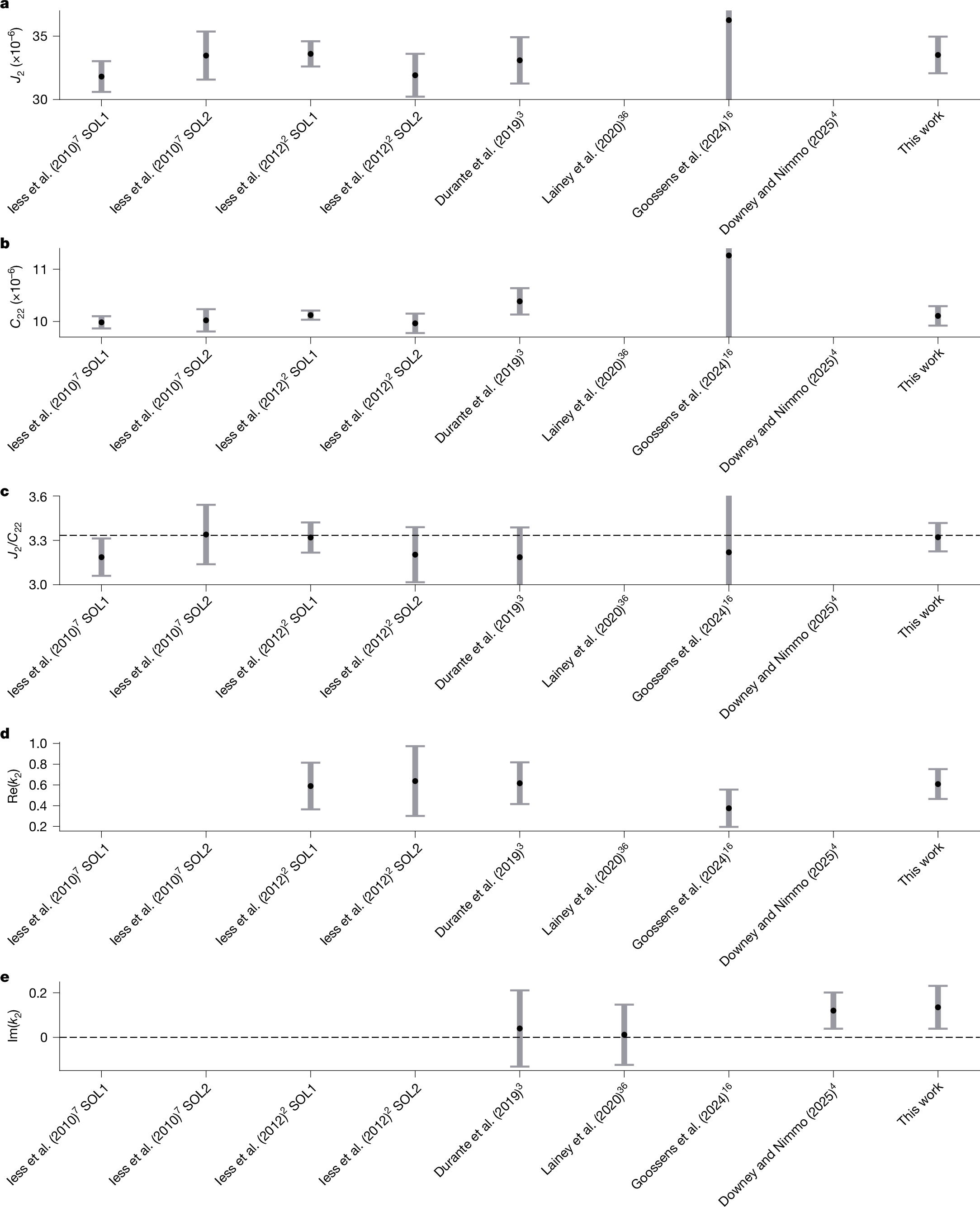
Abstract
The Cassini mission provided unprecedented insights into Saturn’s largest moon, Titan, from its atmosphere to the deep interior1. The moon’s large measured response to the tides exerted by Saturn was interpreted as evidence of the existence of a subsurface ocean2,3. This response, twice the value predicted in pre-Cassini studies, has escaped complete explanation. Here we show that the signature of tidal dissipation in Titan’s gravity field is not consistent with the presence of an ocean. Our results arise from the detection of this signature through a reanalysis of the radiometric data acquired by Cassini with improved techniques. We found that substantial energy is being dissipated in the interior (approximately 3–4 TW, corresponding to a tidal quality factor Q ≈ 5), consistent with recent studies of Titan’s rotational state4. Because the presence of a liquid layer reduces the tidal dissipation generated below it5, these new measurements preclude the existence of a subsurface ocean on Titan and are explained by a model in which dissipation is concentrated in a high-pressure ice layer close to its melting point. This model also reproduces Titan’s observed rotational state and static gravity field self-consistently, reconciling all available geophysical measurements. Efficient ice shell convection can prevent widespread melting and ocean formation, but a slushy high-pressure ice layer is consistent with expectations6, indicating that it probably hosts liquid water pockets. The forthcoming Dragonfly mission to Titan will provide a further test of whether a subsurface ocean exists.

