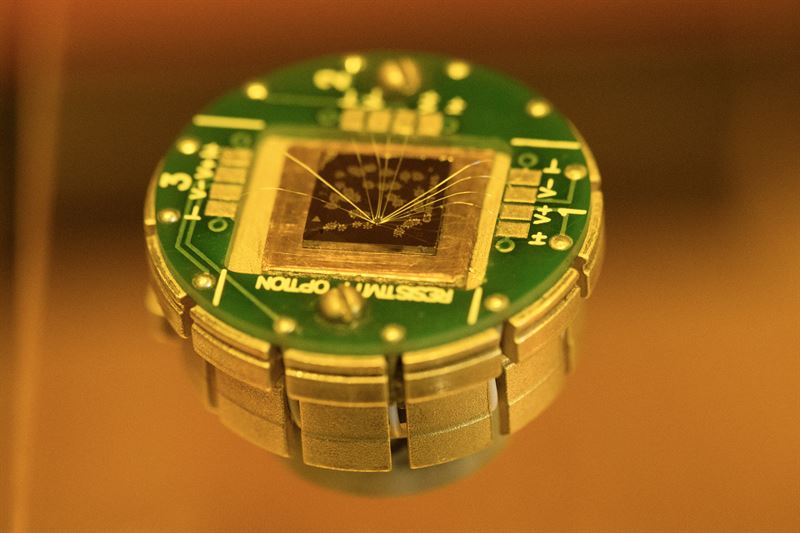
2025-09-26 カリフォルニア大学リバーサイド校(UCR)
<関連情報>
- https://news.ucr.edu/articles/2025/09/26/new-adaptive-optics-support-gravitational-wave-discoveries
- https://opg.optica.org/optica/fulltext.cfm?uri=optica-12-10-1569
重力波検出のための次世代波面アクチュエータの実証 Demonstration of a next-generation wavefront actuator for gravitational-wave detection
Tyler Rosauer, Huy Tuong Cao, Mohak Bhattacharya, Peter Carney, Luke Johnson, Shane Levin, Cynthia Liang, Xuesi Ma, Luis Martin Gutierrez, Michael Padilla, Liu Tao, Aiden Wilkin, Aidan Brooks, and Jonathan W. Richardson
Optica Published: September 26, 2025
DOI:https://doi.org/10.1364/OPTICA.567608
Abstract
In the last decade, the Laser Interferometer Gravitational-Wave Observatory (LIGO) and the European Virgo Observatory have opened a new observational window on the universe. These cavity-enhanced laser interferometers sense spacetime strain, generated by distant astrophysical events such as black hole mergers, to an RMS fluctuation of a few parts in 1021over a multi-kilometer baseline. Optical advancements in laser wavefront control are key to advancing the sensitivity of current detectors and enabling a planned next-generation 40 km gravitational wave observatory in the United States, known as Cosmic Explorer. We report an experimental demonstration of a wavefront control technique for gravitational-wave detection, obtained from testing a full-scale prototype on a 40 kg LIGO mirror. Our results indicate that this design can meet the unique and challenging requirements of providing higher-order precision wavefront corrections at megawatt laser power levels while introducing extremely low effective displacement noise into the interferometer. This technology will have a direct and enabling impact on the observational science, expanding the gravitational-wave detection horizon to very early times in the universe, before the first stars formed, and enabling new tests of gravity, cosmology, and dense nuclear matter.