2025-09-23 ペンシルベニア州立大学(PennState)
Web要約 の発言:
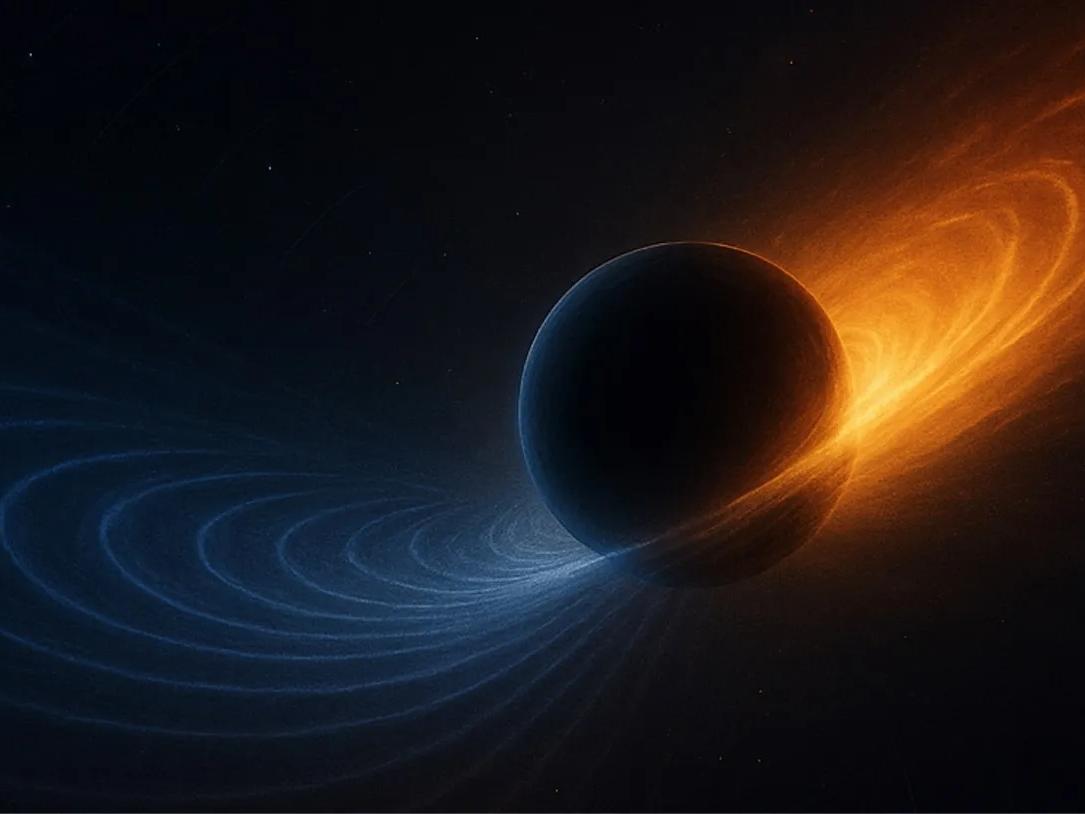
When two black holes collide and merge, they each emit gravitational waves that “kick” the resulting newborn black hole, causing it to rapidly move and sometimes escape its own galaxy. If the two original black holes are of unequal masses, the gravitational waves appear significantly different when detected on Earth. This imbalance allowed an international team of researchers to fully characterize motion of this kick for the first time. Credit: Galician Institute for High Energy Physics. All Rights Reserved.
<関連情報>
- https://www.psu.edu/news/eberly-college-science/story/first-measurement-black-holes-kick-after-cosmic-collision
- https://www.nature.com/articles/s41550-025-02632-5
高次重力波モードによるブラックホール反動の完全測定 A complete measurement of a black-hole recoil through higher-order gravitational-wave modes
Juan Calderón Bustillo,Samson H. W. Leong & Koustav Chandra
Nature Astronomy Published:09 September 2025
DOI:https://doi.org/10.1038/s41550-025-02632-5
Abstract
General relativity predicts that gravitational waves (GWs) carry linear momentum. Consequently, the remnant black hole of a black-hole merger can inherit a recoil velocity or ‘kick’ of crucial implications in, for example, black-hole formation scenarios. While the kick magnitude is determined by the mass ratio and spins of the source, estimating its direction requires a measurement of the two orientation angles of the source. While the orbital inclination angle is commonly reported in GW observations, the scientific potential of the azimuthal one has not been exploited so far. Here we show how the presence of more than one GW emission mode allows one to constrain this angle and, consequently, the kick direction of a real GW event. We analyse the GW190412 signal, which contains higher-order modes, with a numerical relativity surrogate waveform model for black-hole mergers. We rule out kick magnitudes below the typical escape velocity of dense globular clusters vesc ≈ 50 km s−1 with a Bayes factor of ~21 (or ~95% probability). The kick forms angles θ-100MKL=32+35-14 with the orbital angular momentum defined at a reference time tref = −100 M before merger (with M denoting the system mass in geometric units), ΦθKN=44+19-17 deg with the line of sight and -100M KN =69+33-38 with the projection of the latter onto the former, all quoted at a 90% credible level. We anticipate that complete characterization of black-hole recoils will aid in evaluating candidate multi-messenger observations of black-hole mergers in active galactic nuclei, by testing the consistency of observed signals with proposed electromagnetic emission mechanisms.