2025-07-24 産業技術総合研究所
ChatGPT:
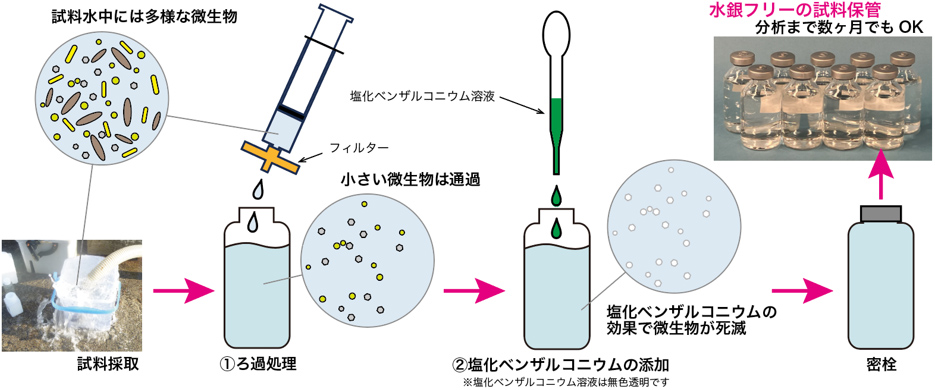 新しく開発した水銀フリーの水試料殺菌手法の概略
<関連情報>
- https://www.aist.go.jp/aist_j/press_release/pr2025/pr20250724/pr20250724.html
- https://os.copernicus.org/articles/21/1395/2025/
放射性炭素分析における水試料の保存中に溶解無機炭素の変質を抑制するため、ベンザルコニウム塩化物の添加と濾過を組み合わせた手法 Combining benzalkonium chloride addition with filtration to inhibit dissolved inorganic carbon alteration during the preservation of water sample in radiocarbon analysis
Hiroshi A. Takahashi and Masayo Minami
Ocean Sciencee Published:21 Jul 2025
DOI:https://doi.org/10.5194/os-21-1395-2025
Abstract
Benzalkonium chloride (BAC) addition has shown great promise as a disinfectant for measuring δ13C and 14C of dissolved inorganic carbon (DIC) in freshwater samples. However, it was reported that the effectiveness of BAC to prevent DIC change was reduced for the use of seawater samples. The present study aims to evaluate the effectiveness of adding BAC as a disinfectant in carbon isotopic analyses of DIC in water samples. We compared the efficacy of BAC addition, filtration (0.22 µm polytetrafluoroethylene (PTFE) or 0.2–0.45 µm polyether sulfone (PES) filters), and a combination of BAC addition and filtration in preventing DIC alterations caused by biological activity using the freshwater (salinity <0.05) and the brackish water (salinity ∼20) samples. The freshwater sample treated with BAC showed no alteration of DIC. In contrast, for the seawater sample, BAC addition alone did not prevent changes in DIC, but the combined treatment was effective. The 14C concentration of samples treated with both BAC addition and filtration exhibited minimal changes, ranging from 0.2–0.4 percent modern carbon (pMC) over 41 weeks despite the addition of sugar included to increase DIC changes several-fold. Although the complete elimination of biological effects may be challenging with the combined method, the observed changes remained within practical limits. Concerns about CO2 contamination during sample filtration were also addressed and found to be negligible. These results suggest that combining filtration and BAC addition is an effective method for suppressing biological DIC alterations in 14C analysis, even in seawater samples.