2025-03-03 東北大学
<関連情報>
- https://www.tohoku.ac.jp/japanese/2025/03/press20250303-03-gas.html
- https://pubs.rsc.org/en/Content/ArticleLanding/2025/DT/D4DT03018D
不飽和有機金属錯体を用いた超高温での水素同位体分離 Hydrogen isotope separation at exceptionally high temperature using an unsaturated organometallic complex
Taku Kitayama,Tamon Yamauchi,Kaiji Uchida,Shunya Tanaka,Ryojun Toyoda,Hiroaki Iguchi,Ryota Sakamoto,Hao Xue,Naoki Kishimoto,Takefumi Yoshida,Tomoya Uruga,Shin-ichiro Noro and Shinya Takaishi
Dalton Transactions Published:23 Dec 2024
DOI:https://doi.org/10.1039/D4DT03018D
Abstract
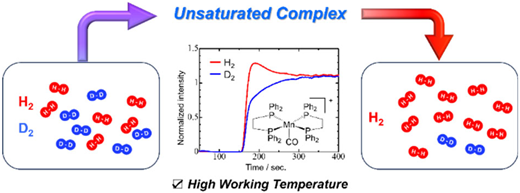
A new approach for hydrogen isotope separation using an unsaturated organometallic complex was proposed. Adsorption measurements of [Mn(dppe)2(CO)(N2)](BArF24) (Mn-dppe) (dppe = 1,2-bis(diphenylphosphino)ethane, BArF24 = B[C6H3(3,5-CF3)2]4) using H2 and D2 revealed a significant difference in the adsorption enthalpy of H2/D2 at much higher room temperatures than in previous studies, with D2 molecules being more strongly adsorbed on unsaturated metal sites. Mixed gas adsorption isotherms were calculated at each temperature using IAST, and it was predicted that D2 uptake was much larger than H2 uptake. Column chromatographic separation using the difference in adsorption enthalpy indicated that deuterium could be concentrated, and DFT calculations suggest that this difference in adsorption force is due to the difference in vibrational potentials involved in metal–dihydrogen bonding. This study introduces a new separation approach that could enable hydrogen isotope separation in the ambient temperature range.