2026-11-09 ブラウン大学
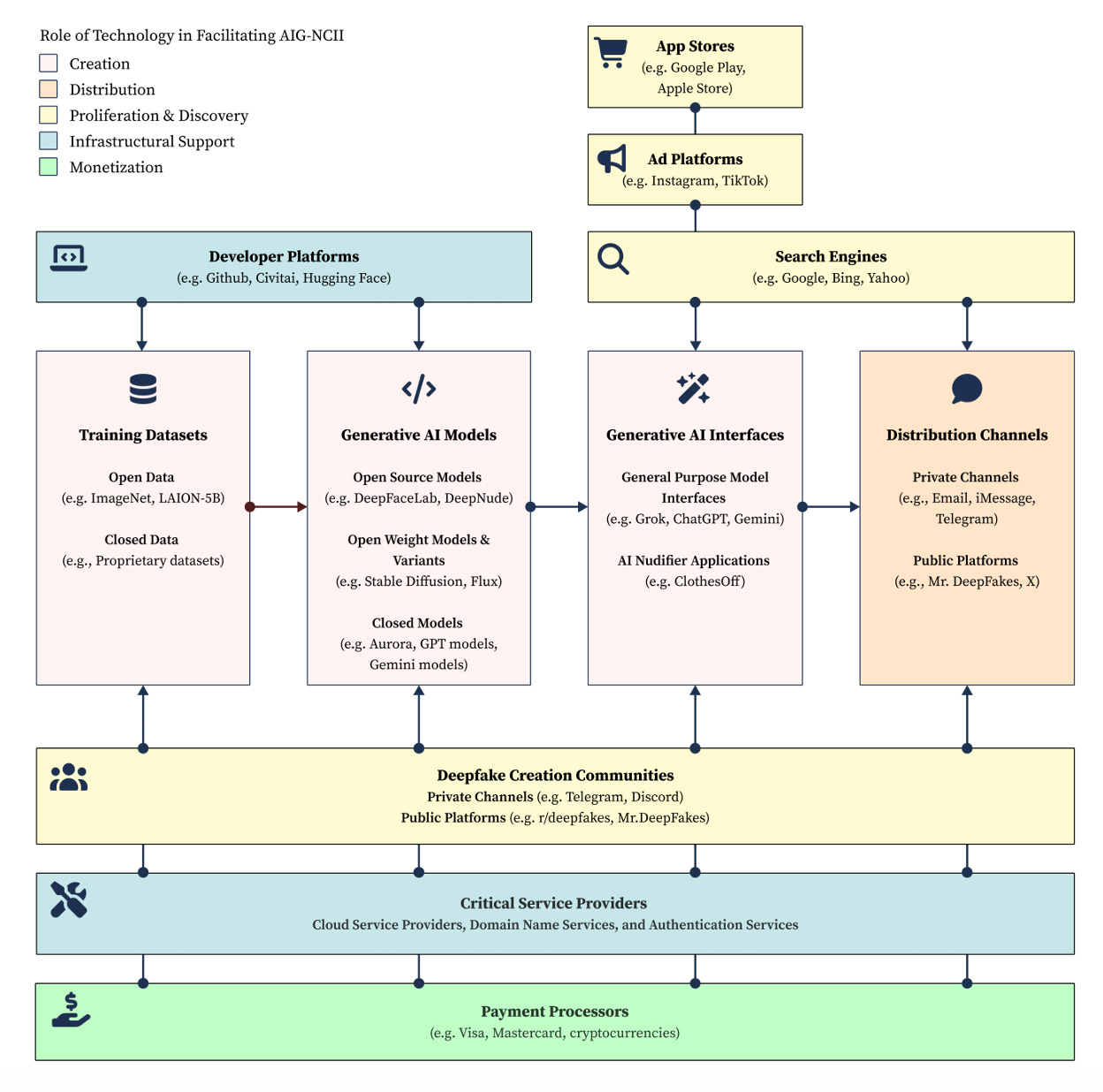
Brown researchers created a taxonomy of technologies that make deepfake abuse possible.
<関連情報>
- https://www.brown.edu/index%2ephp/news/2026-11-09/ai-deepfake-legislation
- https://dl.acm.org/doi/10.1145/3846167.3848604
モグラ叩きゲームをやめる方法:AI生成による非同意の親密な画像を促進するテクノロジーのエコシステムのマッピング How to Stop Playing Whack-a-Mole: Mapping the Ecosystem of Technologies Facilitating AI-Generated Non-Consensual Intimate Images
Michelle L. Ding, Harini Suresh, Suresh Venkatasubramanian
EAAMO ’26: Proceedings of the 6th ACM Conference on Equity and Access in Algorithms, Mechanisms, and Optimization Published: 04 November 2026
DOI:https://doi.org/10.1145/3846167.3848604
Abstract
The last decade has witnessed a rapid advancement of generative AI technology that significantly scaled the accessibility of AI-generated non-consensual intimate images (AIG-NCII), a form of image-based sexual abuse that disproportionately harms and silences women and girls. There is a patchwork of commendable efforts across industry, policy, academia, and civil society to address AIG-NCII. However, these efforts lack a shared, consistent mental model that clearly situates the technologies they target within the context of a large, interconnected, and ever-evolving technological ecosystem. As a result, interventions remain siloed and are difficult to evaluate and compare, leading to a reactive cycle of whack-a-mole. In this paper, we contribute the first comprehensive AIG-NCII technological ecosystem that maps and taxonomizes 11 categories of technologies facilitating the creation, distribution, proliferation and discovery, infrastructural support, and monetization of AIG-NCII. First, we build and visualize the ecosystem through a synthesis of over a hundred primary sources from researchers, journalists, advocates, policymakers, and technologists. Then, we conduct two detailed walkthroughs to demonstrate the usefulness of the ecosystem in 1) making sense of new AIG-NCII harms using a case study of Grok and 2) mapping a clearer tech policy landscape using U.S. federal law and 63 state laws. We conclude with a vision for future AIG-NCII research that refines the edges of the ecosystem, recommending researchers to study critical relationships between technologies and potential ripple effects from different interventions. Our goal is to produce an AIG-NCII technological ecosystem that provides a clear, shared terminology and framework for stakeholders to move into the future of AIG-NCII prevention with clarity and foresight.