2026-11-03 中国科学院(CAS)
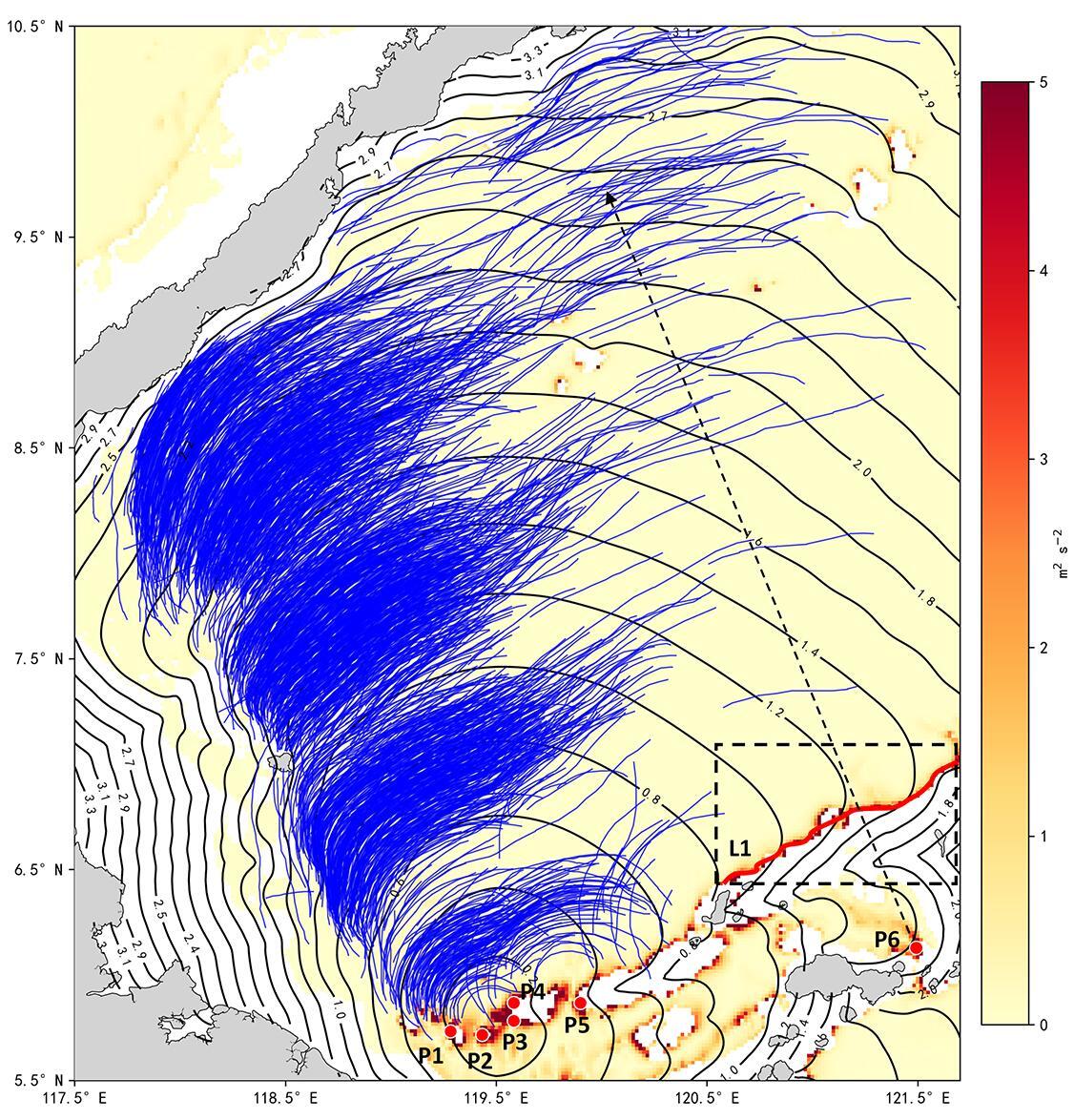
Identification of candidate internal solitary wave generation regions in the Sulu Sea. Blue curves show satellite-observed wave crests, and red markers indicate candidate equivalent sources. (Image by IOCAS)
<関連情報>
- https://english.cas.cn/newsroom/research-news/202611/t20261103_1213105.shtml
- https://ieeexplore.ieee.org/document/11741334
スールー海における複数の発生源からの内部孤立波の衛星データ制約と物理法則に基づく予測 Satellite-Constrained and Physics-Guided Forecasting of Internal Solitary Waves From Multiple Generation Sources in the Sulu Sea
Zhixin Li; Xiaofeng Li; Xudong Zhang
IEEE Transactions on Geoscience and Remote Sensing Published: 19 October 2026
DOI:https://doi.org/10.1109/TGRS.2026.3744681
Abstract
The Sulu Sea is one of the most active regions of internal solitary waves (ISWs), yet accurate forecasting remains challenging because waves originating from multiple generation regions propagate through complex bathymetry under spatially and temporally varying ocean conditions, producing distinct crest patterns. Here, we use multisensor optical satellite observations from Terra, Aqua, and Suomi NPP acquired between 2002 and 2022 to characterize the spatial distribution, propagation properties, and source characteristics of Sulu Sea ISWs. Propagation speeds derived from 142 matched image pairs show a mean value of 2.05 m/s and a dominant northwestward propagation direction. Satellite-observed crest geometry, spring-neap tidal modulation, and barotropic tidal forcing indicate that a single-source representation is insufficient for this region. We therefore used satellite-derived ISW positions and a light gradient boosting machine (LightGBM) surrogate model to identify an optimal set of equivalent sources, consisting of five-point sources near Pearl Bank and the adjacent sill-shoal system, and one equivalent line source in the northeastern Sulu Sea. Based on this source set, we develop a physics-data hybrid forecasting model multiple-source Eikonal and satellite residual forecasting (MESRF) that combines multisource Eikonal equation guidance with satellite-derived residual correction. On an independent optical test set of 92 satellite images acquired from 2023 to 2026, MESRF yields a propagation-time root mean square error (RMSE) of 1.38 h, reducing the error by 70.40% relative to a conventional empirical Eikonal approach that assumes a single generation source. The same optical test further yields an arrival-time mean absolute error (MAE) of 1.27 h and a crest-position MAE of 9.05 km. An additional independent evaluation using synthetic aperture radar (SAR) images yields a propagation-time RMSE of 1.95 h, an arrival-time MAE of 2.28 h, and a crest-position MAE of 14.38 km, supporting the cross-sensor applicability of MESRF. These results show that satellite-derived source optimization can extend Eikonal-based ISW forecasting from single-source settings to marginal seas with multiple generation regions.