2026-07-06 エディンバラ大学
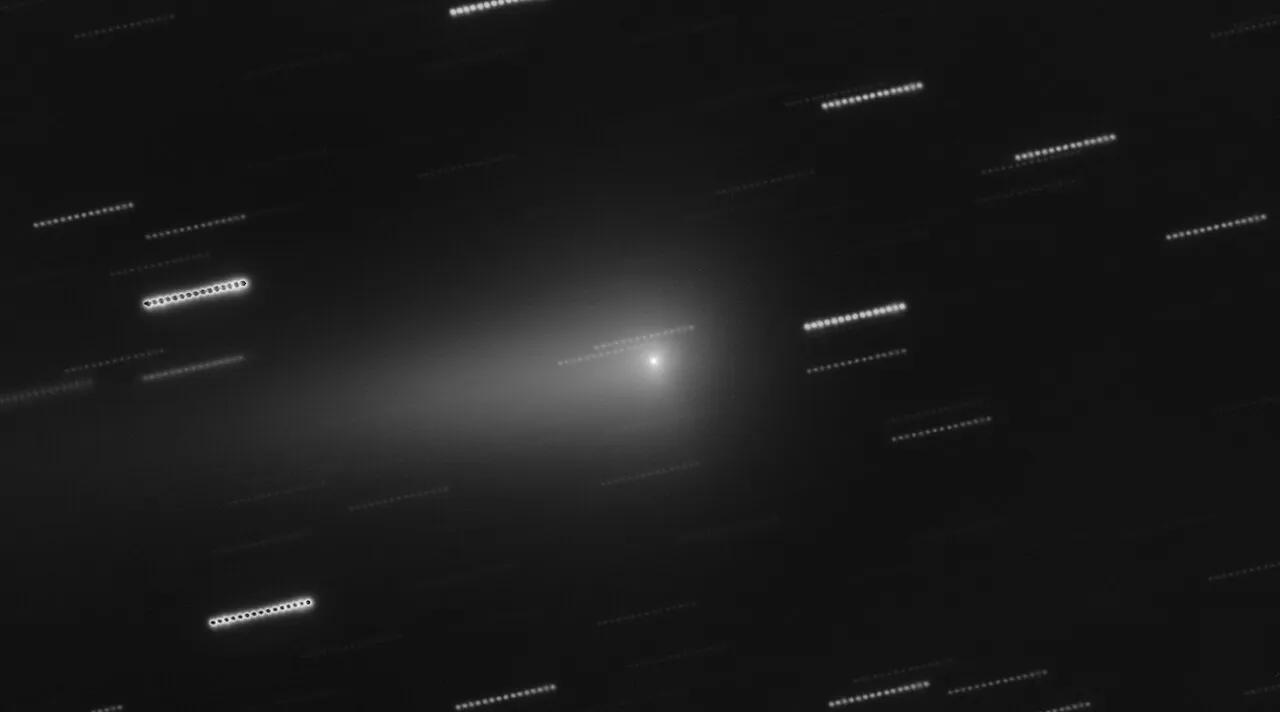
Image of interstellar comet 3I/ATLAS- taken 18 January 2026. Credit- ESOO Hainaut.
<関連情報>
- https://www.ed.ac.uk/news/clues-to-comets-ancient-origin-revealed
- https://www.nature.com/articles/s41550-026-02921-7
星間彗星3I/ATLASにおける高窒素および高炭素同位体比 High nitrogen and carbon isotopic ratios in the interstellar comet 3I/ATLAS
C. Opitom,J. Manfroid,D. Hutsemékers,E. Jehin,M. M. Knight,K. Aravind,L. Ferellec,D. Bodewits,V. V. Guzmán,M. Cordiner,R. C. Dorsey,F. La Forgia,M. Lippi,B. P. Murphy,C. Snodgrass & M. Bannister
Nature Astronomy Published:06 July 2026
DOI:https://doi.org/10.1038/s41550-026-02921-7
Abstract
Interstellar objects provide a unique opportunity to deepen our understanding of planetary formation by enabling detailed study of material formed around other stars. Their ices contain precious clues about the environment and conditions prevailing in their home system. As fractionation processes can be sensitive to the temperature and radiation environment, isotopic ratios are powerful tracers of the origin and evolution of different species. While isotopic ratios have been measured in Solar System comets, previously detected interstellar objects have been too faint to measure isotopic ratios. Here we report the measurement of two ratios in 3I/ATLAS from observations of the CN molecule: 12C/13 = C151+110-44 and 14N/15N =363+633-153 . The 14N/15N is higher than the value of ~150 usually measured for Solar System comets, close to the values measured in the interstellar medium, prestellar phases or outside of protoplanetary disks. The 12C/13C is higher than the values usually measured for Solar System comets and in the local interstellar medium. These measurements are compatible with an origin of 3I in the outer disk around an older low-metallicity star, providing potential insights into the likelihood and efficiency of planetesimal formation around such stars.