
2026-04-08 ノースウェスタン大学
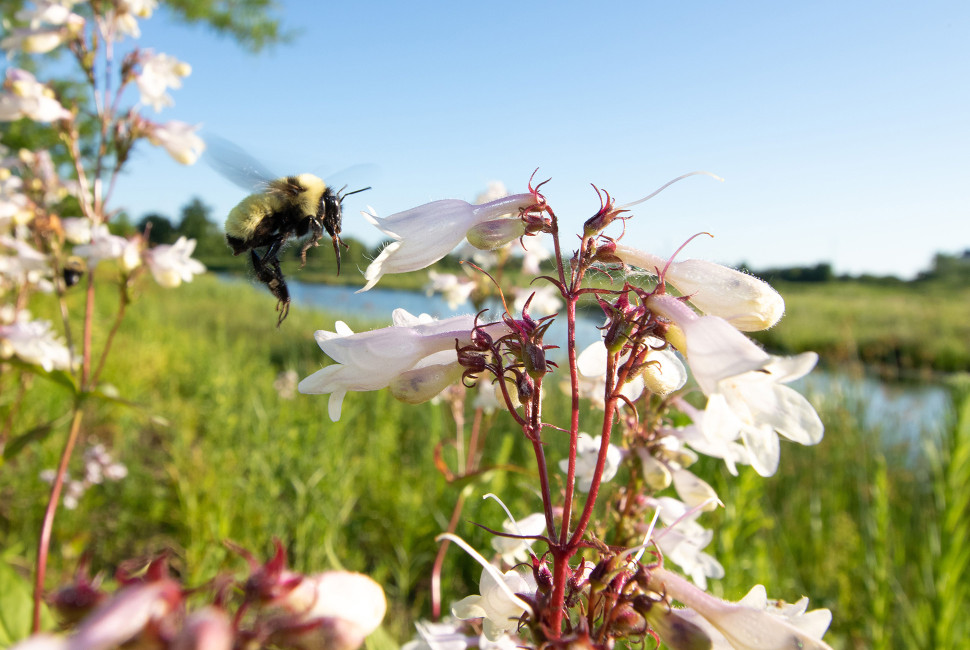
Some cultivated plants — bred for their compact forms and uniform visual appeal — can still provide meaningful support for pollinators, offering a more approachable entry point for those looking to create a pollinator garden. Above, a golden northern bumble bee visits a foxglove beardtongue. Photo by Nick Dorian
<関連情報>
- https://news.northwestern.edu/stories/2026/4/pollinator-friendly-gardens-dont-have-to-sacrifice-style
- https://esajournals.onlinelibrary.wiley.com/doi/10.1002/ecs2.70566
受粉媒介昆虫のための庭園に適した品種の評価 Evaluating cultivars for pollinator gardens
Nicholas N. Dorian, Imeña R. Valdes, Paul J. CaraDonna, Jessamine Finch, Richard Hawke, Amy M. Iler, Kayri Havens
Ecosphere Published: 01 April 2026
DOI:https://doi.org/10.1002/ecs2.70566
Abstract
Pollinator gardening is a rapidly growing community-based conservation movement, yet evidence-based guidelines for practice are largely missing. In particular, it is unclear whether cultivars of flowering plants (i.e., horticultural varieties)-can support pollinators as effectively as their wild-type counterparts. This uncertainty stems from two knowledge gaps: first, cultivars are assumed to be universally unattractive to pollinators despite evidence of cultivar-specific responses and second, it is unclear whether attractiveness of wild-type plants and cultivars measured at a single location holds across growing contexts. We addressed these knowledge gaps by determining pollinator attractiveness (measured as visitation rate and morphogroup richness) of four native wild-type forbs and 13 cultivars using data from a 2-year common garden trial and a 5-year community science project across eastern North America. Across datasets, wild-type plants were consistently the most attractive to pollinators. In contrast, cultivars varied in their attractiveness, with some cultivars matching wild type and others exhibiting lower attractiveness than wild type; no cultivar outperformed its wild-type counterpart. Taxon-specific visitation rates strongly aligned across datasets, indicating that common garden evaluations may hold across diverse landscape contexts and that community science can advance understanding of ecological interactions at large spatial scales. Together, these findings provide actionable guidance for pollinator-friendly plantings. For the evaluated taxa, we recommend wild-type plants, which were highly attractive to pollinators, and cultivars that matched wild-type plants in evaluated attractiveness. In practice, cultivars may be practical complements to native wild-type plants, particularly when aesthetic norms and limited wild-type availability constrain planting choices, but should not be assumed to be ecologically equivalent to wild-type plants by default.


