2026-04-08 合肥物質科学研究院(HFIPS)
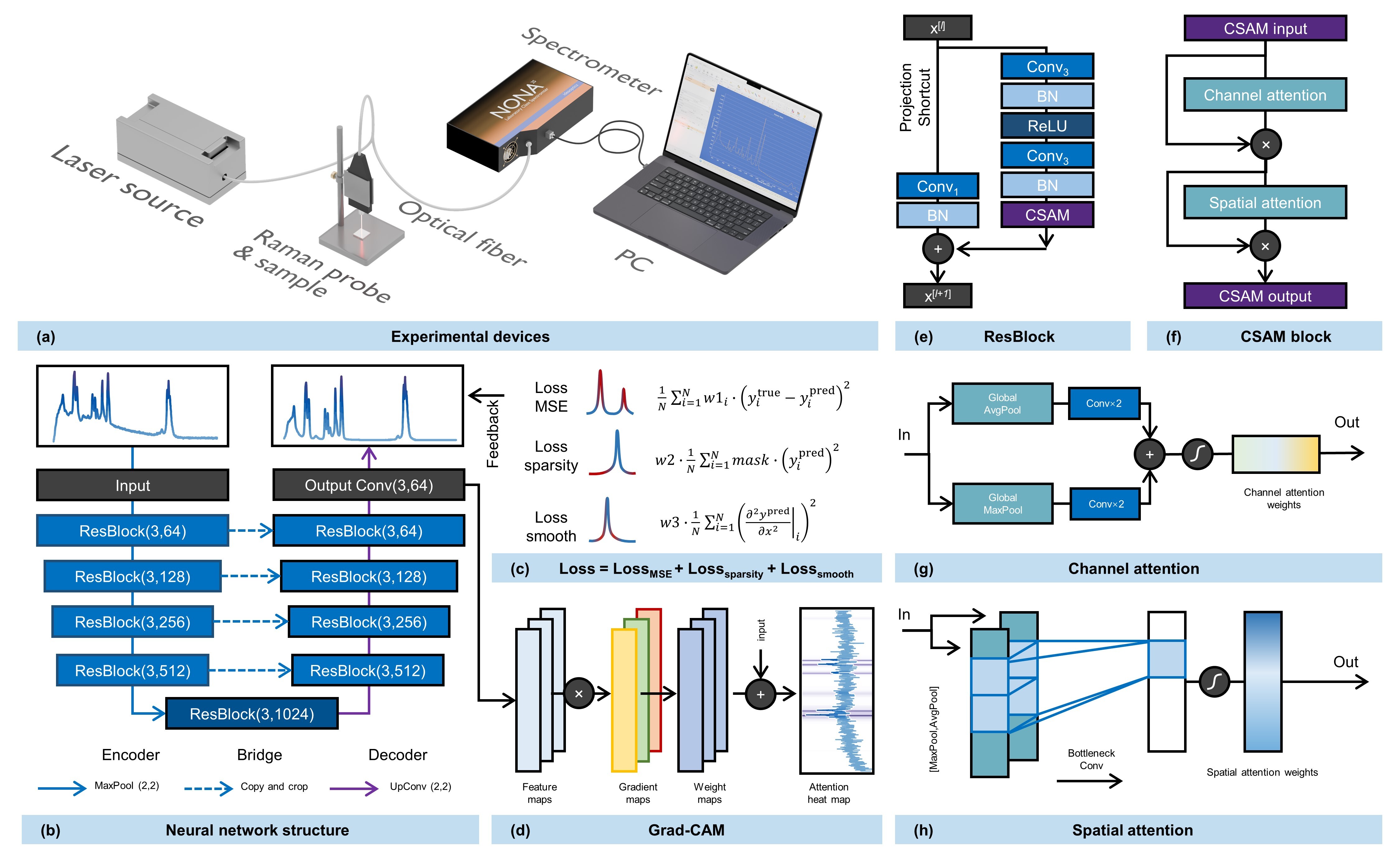
The Raman spectra of detected microplastics are input into a neural network trained to output clean Raman spectra. Spatial and channel attention modules enhance the model’ s performance. Training is optimized using a custom loss function. Grad-CAM visualizations highlight the regions of the spectra that the neural network identifies as significant. (Image by HUANG Weixiang)
<関連情報>
- https://english.hf.cas.cn/nr/rn/202604/t20260408_1155372.html
- https://pubs.acs.org/doi/10.1021/acs.analchem.5c04049
混合マイクロプラスチックのラマンスペクトルの再構築、分類、および分離のためのカスケード型改良ニューラルネットワーク Cascaded Improved Neural Network for the Reconstruction, Classification, and Unmixing of the Raman Spectra of Mixed Microplastics
Weixiang Huang,Jiajin Chen,Hao Xiong,Ligang Shao,Guishi Wang,Kun Liu,Chilai Chen,and Xiaoming Gao
Analytical Chemistry Published: March 9, 2026
DOI:https://doi.org/10.1021/acs.analchem.5c04049
Abstract
Raman spectroscopy is a highly specific and sensitive analytical modality that, when combined with a neural network, has been extensively studied for characterizing microplastics. However, challenges remain in analyzing mixed microplastic Raman spectra. Identification is complicated by interference among characteristic peaks from multicomponents. The efficacy of neural networks is diminished under complex environmental conditions. Traditional preprocessing algorithms are characterized by their sensitivity to parameters and their inefficiency in the analysis of voluminous data sets. To address these challenges, in this work, a solution for processing mixed microplastic Raman spectra is proposed, utilizing a cascaded ResUNet with a channel and spatial attention module (CSAM-ResUNet) neural network, which enables stable reconstruction, effective classification, and unmixing. In spectral denoising and baseline correction, CSAM-ResUNet exhibits superior performance in comparison to the general attention module. Building upon the improvements achieved by the enhanced ResUNet with Squeeze-and-Excitation over the standard ResUNet, CSAM-ResUNet achieves a further 32% reduction in mean squared error. Compared to traditional algorithms, it has been demonstrated to enhance the peak signal-to-noise ratio by 35% and structural similarity by 80%. CSAM-ResUNet is utilized for the classification and unmixing of Raman spectra of microplastics under a range of experimental conditions, including instances of inadequate laser power and reduced acquisition times. Among the experimental conditions tested, in an optimal condition, the model demonstrated an accuracy of 99.68% in the classification of 21 mixed microplastic classes. In a nonideal condition where the sample’s received energy is reduced to 20%, the accuracy rate remains above 90%. In the process of unmixing, the majority of the unmixed spectra exhibited precise peak assignments, corresponding to the characteristic peaks of the respective microplastics. This solution realizes a more complete and comprehensive application of neural networks in Raman spectral processing. It demonstrates the ability of the neural network for the rapid processing and classification of the Raman spectra of microplastics with mixed components.