2026-03-30 統計数理研究所
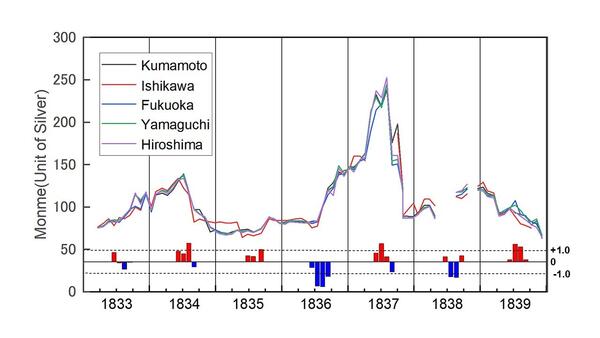
図:天保の大飢饉期における日射量と米価の推移
<関連情報>
1830年代の飢饉における異常な太陽放射とそれが日本の米市場に与えた影響 Unusual solar radiation and its impact on the Japanese rice market during the 1830s famine
Mika Ichino,Kooiti Masuda,Takehiko Mikami & Yasuo Takatsuki
Scientific Reports Published:18 February 2026
DOI:https://doi.org/10.1038/s41598-026-40316-w
Abstract
We investigated the interplay between climatic anomalies and economic fluctuations in early modern Japan (1603 − 1867), focusing on the Tenpō Famine of the 1830s. Specifically, we reconstructed solar radiation from 1821 to 1850 using descriptions from 18 historical diaries. This represents a novel approach to analyzing climatic impacts on agriculture and the economy during this period. The results suggest that reduced solar radiation, indicative of poor weather conditions, was followed by a substantial increase in rice prices, which rose to three to four times the normal level (from 50-70 to around 200). This rise occurred particularly during the summer of 1836, when solar radiation in July and August was approximately 10% below normal, and cold conditions persisted for three months. Applying principal component analysis to the reconstructed solar radiation data revealed spatiotemporal patterns that elucidated the link between climatic anomalies and their impacts on market prices during the Tenpō Famine. This indicates the sensitivity of market prices and economic stability to climate fluctuations. Using monthly rather than annual data, this study offers further evidence for the connections between climate, agriculture, and economic fluctuations. Our findings provide historical perspectives that could contribute to broader considerations in climate adaptation and policymaking. Additionally, this study suggests further research directions and encourages continued exploration of the relationship among climate change, agriculture, and economic fluctuations, inspiring future research in this field.