
2026-03-25 中国科学院(CAS)
中国科学院西双版納熱帯植物園(XTBG)と東北林業大学の研究チームは、異なる気候条件下で森林の樹木が水輸送・糖分配・貯蔵のバランスをどのように調整するかを比較した。中国の熱帯から温帯まで4地域で55種の林冠木本植物を調査した結果、寒冷・高緯度・高標高地域の樹木は、葉面積あたり木部や師部への投資が大きく、凍結融解への耐性や貯蔵機能を重視する傾向が示された。一方、同一環境内では樹形の違いを超えて機能配分が収束し、環境フィルタリングの影響が支配的であることが判明。これらの知見は、気候変動下での森林管理・保全に重要な示唆を与える。
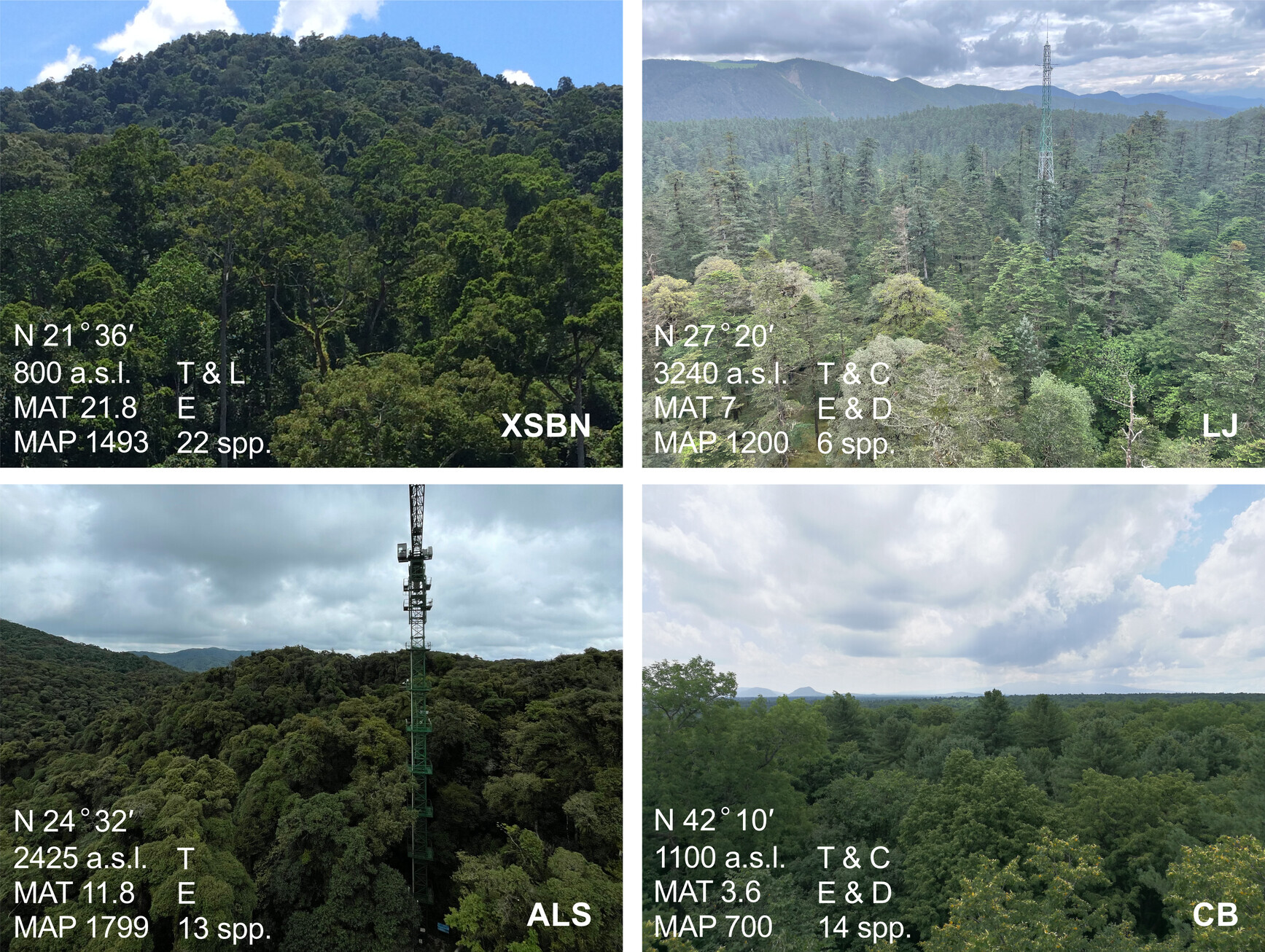
Canopy view of the four typical Chinese forests. (Image by XTBG)
<関連情報>
- https://english.cas.cn/newsroom/research-news/202603/t20260325_1153783.shtml
- https://nph.onlinelibrary.wiley.com/doi/10.1111/nph.71049
55種の樹冠植物では、気候によって機能比は異なるが、環境内では収束する Functional ratios diverge across climates but converge within environments in 55 woody canopy plants
Lan Zhang, Frank Sterck, Yajun Chen, Jinlong Dong, Hua Huang, Guanhua Dai, Huazheng Lu, Zhiyun Lu, Jinhua Qi, Jin Li, Keping Ma
New Phytologist Published: 10 March 2026
DOI:https://doi.org/10.1111/nph.71049
Summary
- Functional coordination among leaf, xylem, phloem and ray parenchyma governs the carbon–water economy of woody plants, yet the allocation principles and climatic drivers remain poorly explored. We hypothesized that species at lower altitudes and/or latitudes invest more in xylem and phloem per unit leaf area to compensate for higher transpirational losses, whereas species from higher altitudes and/or latitudes allocate proportionally more to ray parenchyma to enhance storage.
- Using canopy cranes across four Chinese forests, we quantified how leaf area, branch tissue cross-sectional areas, constituent cell types and functional traits for 55 canopy species varied and coordinated along altitudinal and latitudinal gradients.
- Contrary to the hypothesis that warmer climates favour greater xylem and phloem investment per leaf area, we found lower xylem-to-leaf and phloem-to-leaf ratios at low altitudes/latitudes, while ray-parenchyma-to-leaf ratios increased with altitude.
- Our findings demonstrate that functional ratios diverge across climates but converge within similar environments, suggesting environmental filtering drives storage-transport balances. In contrast to our expectation, trees in cold climates prioritize ray-parenchyma storage or hydraulic capacity, likely due to short growing seasons and freeze–thaw embolism repair needs. Our results imply that coordinated tissue allocation acts as an important adaptive for balancing transport and storage across diverse environments.

、令和6年4月1日発生)](https://tiisys.com/wp-content/uploads/2026/03/スクリーンショット-2026-03-26-171847-500x143.png "日本航空ボーイング787-8の事故[機体の動揺による客室乗務員の負傷](成田国際空港の南東約150km、高度約17,000ft(FL170)、令和6年4月1日発生)")
