2026-03-23 産業技術総合研究所
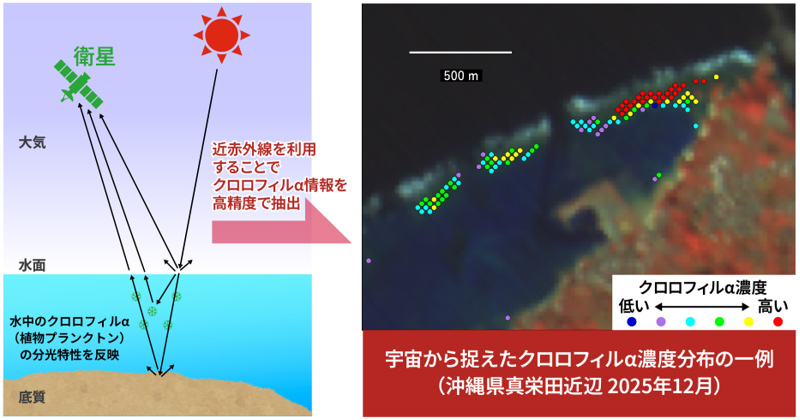
衛星センサーが捉える反射スペクトルには、水面で反射した光や水中の植物プランクトンや陸域から流入する浮遊物による光、底質からの反射光など、さまざまな要素が混ざっている。特に沿岸の浅海域では、底質反射や陸域由来の物質の影響が大きいため、従来の可視光観測ではクロロフィルα濃度の推定が難しいという課題があった。今回、近赤外域のハイパースペクトルデータを活用することで、複雑な沿岸環境からクロロフィルα濃度の推定に成功した。※原論文の図を引用・改変したものを使用。
<関連情報>
- https://www.aist.go.jp/aist_j/press_release/pr2026/pr20260323/pr20260323.html
- https://agupubs.onlinelibrary.wiley.com/doi/10.1029/2025JG009443
宇宙から沿岸部のクロロフィルα濃度をモニタリングするための710nmと800nmにおける二重ピークのハイパースペクトル特性 Double-Peaked Hyperspectral Features at 710 and 800 nm for Monitoring Coastal Chlorophyll-α Concentrations From Space
Satoru Yamamoto, Masaru Mizuyama, Moe Matsuoka, Ayame Ikeda, Hiroki Mizuochi, Akira Iguchi
Journal of Geophysical Research: Biogeosciences Published: 07 March 2026
DOI:https://doi.org/10.1029/2025JG009443
Abstract
The concentration of chlorophyll-α has been estimated from sea color, primarily based on the reflectance ratio between the blue and green spectral bands in multiband images obtained by satellite optical sensors. However, this method is only effective in open, clear water and cannot be reliably applied to shallow coastal waters. In this study, we propose the potential use of double-peaked features at wavelengths of 710nm and 800nm in hyperspectral reflectance data as indicators of the chlorophyll-α concentration in shallow coastal waters. We conducted data mining to identify spectra exhibiting the double-peaked features in reflectance data obtained by the Hyperspectral Imager Suite (HISUI) over coastal regions of Okinawa Island, Japan. Our analysis revealed that the detection points with the double-peaked features are clustered in specific shallow coastal areas, such as reefs and coves, where biological activity is expected to be high, especially around Maeda and Yakata. For these detection points, the spectral relationship between peak strengths at 710nm and 800nm can be categorized into distinct trends, which appear to depend on local variations in the chlorophyll-α concentration. In addition, in situ measurements using FieldSpec confirmed the presence of double-peaked features at Yakata and Maeda, whereas such features were absent at non-detection points. These findings suggest that the double-peaked features in hyperspectral data can be used to reliably detect elevated chlorophyll- concentrations in shallow coastal waters. This method is expected to be useful for monitoring coastal ecosystem activity over time in shallow coastal waters.
Plain Language Summary
Healthy coastal ecosystems are important for diverse shallow-water organisms. One way to check ecosystem health is by measuring chlorophyll-α, the pigment in plants and algae. Satellites remote-sensing can estimate chlorophyll-α by analyzing the color of the ocean, but this method often fails in shallow coastal waters because the seafloor and sediments affect the color. In this study, we tested a new approach using hyperspectral satellite images, which provide detailed color information. We found that a unique pattern (“double-peaked” features) appears near 710nm and 800nm in hyperspectral data, associating with higher chlorophyll-α levels. We observed these features in shallow areas like reefs and coves around Okinawa Island, Japan, and confirmed them with field measurements. This discovery means we can use satellite data to better monitor water quality in coastal regions. It could help track ecosystem changes over time and understand the impact of human activities such as development and pollution.