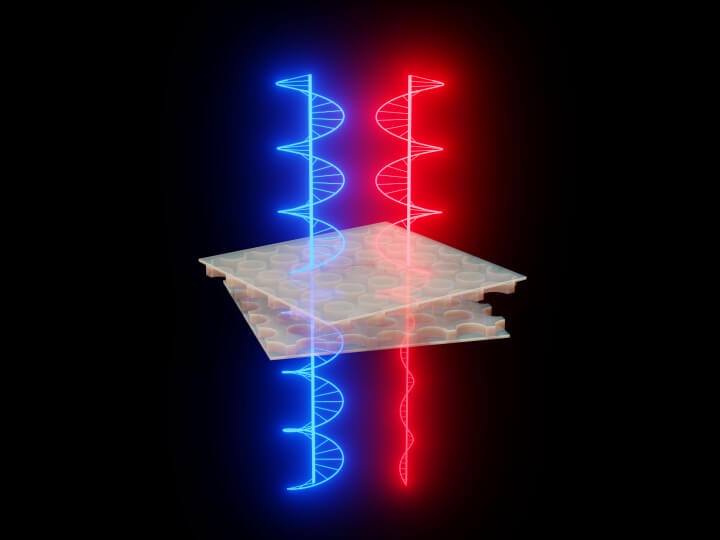
2026-03-09 タフツ大学
<関連情報>
- https://now.tufts.edu/2026/03/09/tufts-student-serves-fresh-solutions-pancake-problem
- https://arxiv.org/abs/2511.15864
- https://arxiv.org/pdf/2511.15864
珍しいナイフでパンケーキを切る Cutting a Pancake with an Exotic Knife
David O. H. Cutler, Neil J. A. Sloane
arXiv last revised 20 Dec 2025 (this version, v2)
DOI:https://doi.org/10.48550/arXiv.2511.15864

Abstract
In the first chapter of their classic book “Concrete Mathematics”, Graham, Knuth, and Patashnik consider the maximum number of pieces that can be obtained from a pancake by making n cuts with a knife blade that is straight, or bent into a V, or bent twice into a Z. We extend their work by considering knives, or “cookie-cutters”, of even more exotic shapes, including a k-armed V, a chain of k connected line segments, a long-legged version of one of the letters A, E, H, L, M, T, W, or X, a convex polygon, a circle, a phi, a figure 8, a pentagram, a hexagram, or a lollipop. In many cases a counting argument combined with Euler’s formula produces an explicit expression for the maximum number of pieces. “Constrained” versions of the long-legged letters A and T are also considered, for which we have only conjectural formulas.