2026-03-10 東北大学
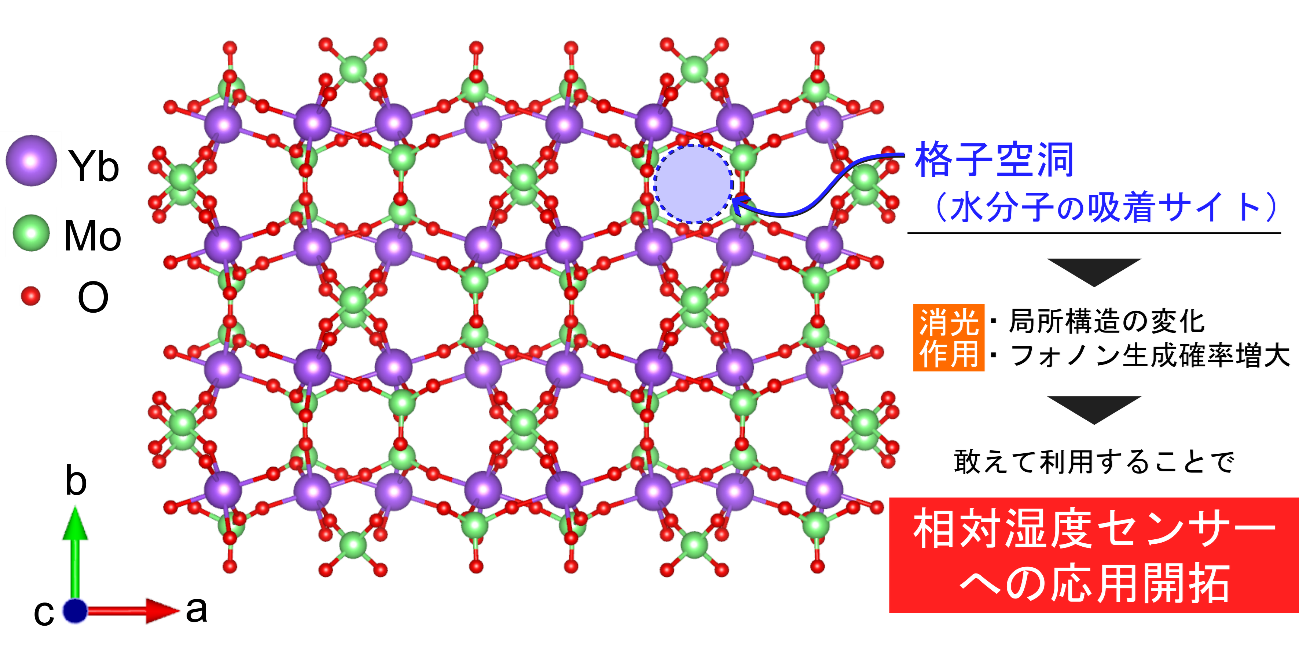
図1. Yb2(MoO4)3の結晶構造モデル。YbO6八面体とMoO4四面体が三次元的に連結した骨格と、水分子を収容できる格子空洞を示す。結晶構造はVESTAプログラムにより描画した。
<関連情報>
- https://www.tohoku.ac.jp/japanese/2026/03/press20250310-01-Yb.html
- https://www.tohoku.ac.jp/japanese/newimg/pressimg/tohokuuniv-press20260310_01web_Yb.pdf
- https://pubs.acs.org/doi/10.1021/acsami.5c23088
Yb2(MoO4)3:Er3+アップコンバージョン蛍光体の強度と寿命変調に基づくデュアルモード湿度センシング Dual-Mode Humidity Sensing Based on Intensity and Lifetime Modulation of Yb2(MoO4)3:Er3+ Upconversion Phosphor
Reiko Furukawa,Takuya Hasegawa,Tomoyo Goto,Yasushi Sato,Ayahisa Okawa,Shu Yin
ACS Applied Materials & Interfaces Published: March 3, 2026
DOI:https://doi.org/10.1021/acsami.5c23088
Abstract
Optical sensors have recently attracted considerable attention because of their remarkable advantages, including fast response, high spatial resolution, noncontact measurement capability, and excellent sensitivity. Harnessing intrinsic lattice features for functional sensing offers a promising pathway toward material design. Herein, we strategically exploit the structural characteristics of orthorhombic Yb2(MoO4)3 (space group Pbcn)─comprising a three-dimensional framework of corner-sharing YbO6 octahedra and MoO4 tetrahedra with accessible lattice voids─to achieve dual-mode optical humidity sensing. Er3+-doped Yb2(MoO4)3 phosphors were synthesized via a hydrothermally assisted method and exhibited both upconversion (UC) and downshifting (DS) luminescence under a 980 nm excitation. The presence of nanoscale lattice cavities capable of accommodating H2O molecules enabled humidity-dependent modulation of the optical response through nonradiative coupling between the high-energy O–H vibrations and excited states of Yb3+/Er3+. Upon switching from dry air to 90% relative humidity (RH), the UC green emission intensity decreased to approximately 30% of its initial value, and the luminescence lifetime shortened from 50 to 40 μs, both recovering reversibly upon dehydration. These variations followed the Langmuir–Hinshelwood-type adsorption kinetics, confirming that surface-adsorbed water molecules govern the luminescence modulation. The combination of reversible lattice hydration and a robust host framework endow Yb2(MoO4)3:Er3+ with high sensitivity, repeatability (>95%), and dual-mode functionality (intensity and lifetime) at room temperature. This study demonstrates a structure-guided design strategy for converting the inherent hygroscopicity of molybdate frameworks into a robust optical sensing mechanism, paving the way for multifunctional luminescent materials for environmental monitoring.