2026-03-05 中国科学院(CAS)
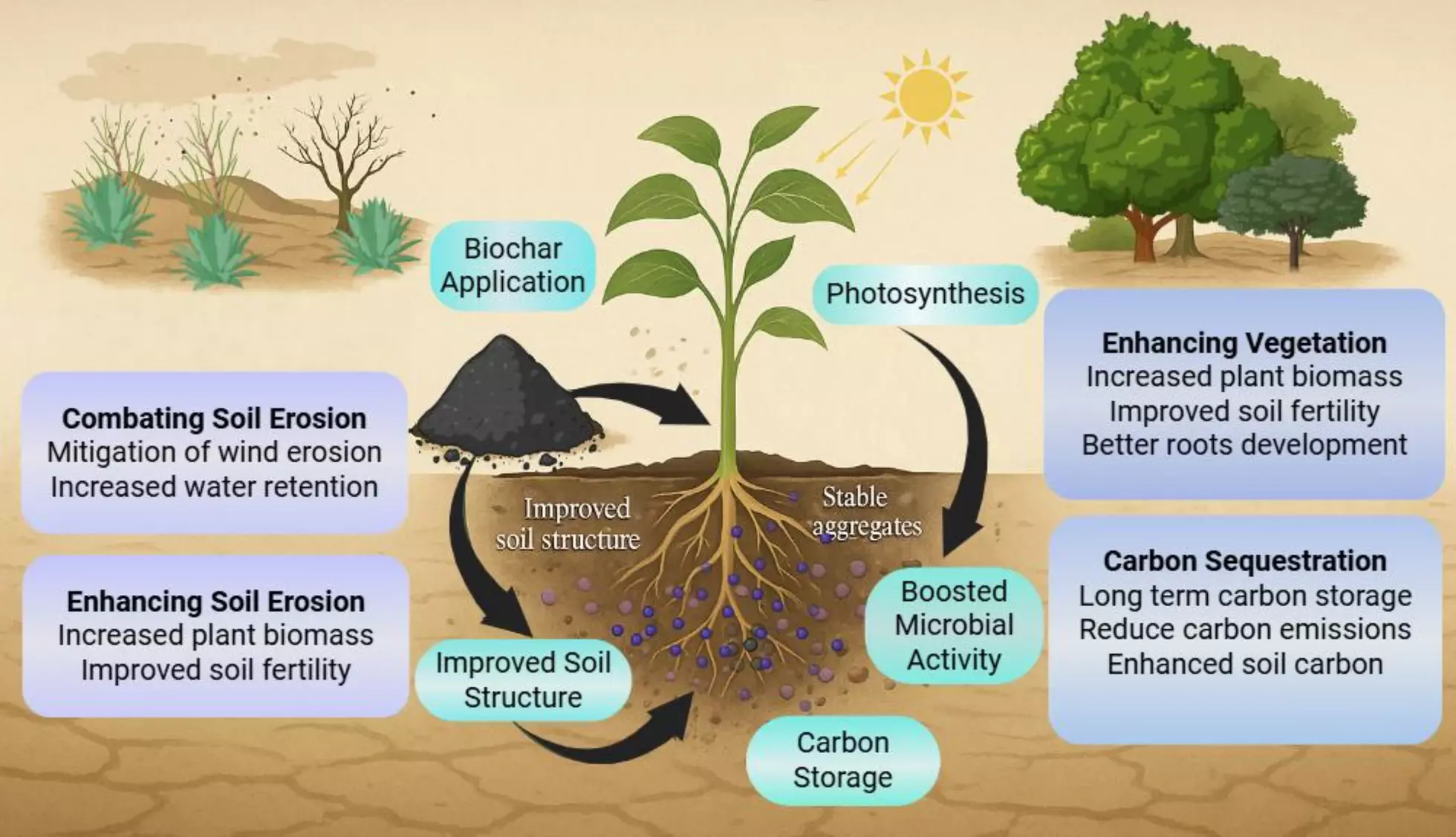
Mechanisms by which biochar mitigates desertification in arid regions. (Image by XIEG)
<関連情報>
- https://english.cas.cn/newsroom/research-news/202603/t20260305_1151482.shtml
- https://link.springer.com/article/10.1007/s42773-025-00537-0
乾燥地土壌の回復と砂漠化の緩和のための気候に配慮した戦略としてのバイオチャール Biochar as a climate-smart strategy for restoring dryland soils and mitigating desertification
Abdul Waheed,Qiao Xu,Dong Cui,Murad Muhammad,Hailiang Xu,Aishajiang Aili,Amannisa Kuerban & Sajjad Ali
Biochar Published:18 February 2026
DOI:https://doi.org/10.1007/s42773-025-00537-0
Abstract
Arid and semi-arid regions are increasingly vulnerable to desertification, soil degradation, and water scarcity, which severely threaten agricultural productivity, food security, and ecosystem stability. This review explores biochar as a climate-smart, integrative, nature-based solution to address these critical challenges, enhance water use efficiency, and build resilience in fragile dryland ecosystems. We hypothesize that strategically designed biochar systems aligned with consistent feedstock logistics, economic viability, and site-specific hydrological and biogeochemical needs can serve as scalable, multi-functional interventions to restore degraded soils and mitigate climate-driven desertification. To test this hypothesis, we critically synthesize interdisciplinary literature, uncovering underexplored synergistic roles of biochar in hydrological regulation, microbial ecology, and renewable energy integration. By consolidating data on biochar’s physicochemical properties, we examine its mechanisms for improving soil structure, boosting water retention, enhancing nutrient cycling, buffering pH, and supporting microbial communities in dryland soils. Field evidence further demonstrates biochar’s capacity to rehabilitate soils, increase crop yields, and reduce erosion risks. We also highlight emerging opportunities at the intersection of biochar and precision agriculture, such as drone-assisted applications, co-composting to produce nutrient-rich biochar, and integration with solar-powered irrigation. Given the accelerating trends of land degradation and climate variability, there is an urgent need to optimize biochar systems for specific soil–climate contexts, quantify long-term carbon sequestration, and assess ecosystem-level impacts. Overcoming challenges related to high production costs, feedstock variability, and ecological uncertainties will require coordinated, multidisciplinary efforts. In conclusion, this review emphasizes biochar’s multifaceted role as a transformative strategy for climate-resilient agriculture and sustainable land management in drylands.