2026-01-19 大阪大学
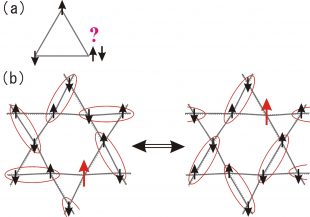
(a) 三角形の格子における電子スピンのフラストレーションの例。図中の矢印はスピンを表している。(b)スピンが揺らいでいる概念図。 孤立スピン(赤矢印)がさまよい、電子の対(赤い楕円)も揺らいでいる様子。格子を少し歪ませて書いています。
<関連情報>
- https://www.sci.osaka-u.ac.jp/ja/topics/16265/
- https://www.sci.osaka-u.ac.jp/ja/wp-content/uploads/2020/08/pr_hanasaki-2.pdf
- https://www.pnas.org/doi/10.1073/pnas.2517926123
スピネルチタン酸塩における氷型構造揺らぎを伴うフラストレートランダムシングレット状態 Frustrated random-singlet state with ice-type structural fluctuation in spinel titanates
Noriaki Hanasaki , Takayuki Hattori, Takumi Komoda, +16 , and Hideaki Sakai
Proceedings of the National Academy of Sciences Published:December 30, 2025
DOI:https://doi.org/10.1073/pnas.2517926123
Significance
To date, the spin liquid state has been investigated in the quantum spin systems in the frustrated lattice. It is theoretically suggested that not only the quantum nature of the spin but also the disorder contributes to the spin fluctuating and resonating in the frustrated lattice. The spinel titanates have the disorder of the ice-type displacement. On the verge of the disappearance of the ice-type atomic displacement, we show that the nonmagnetic spin singlet pairs and the orphan spins coexist, and these spins are fluctuating on a nanosecond time scale. These observations establish the emergence of a frustrated random-singlet state, which was theoretically predicted.
Abstract
In ice, it is well known that the orientation of H2O molecules is disordered by geometrical frustration. Ice-analogous materials having a pyrochlore lattice display interesting phenomena such as the spin-ice state and the magnetic monopole. In the spinel titanate MgTi2O4, the Ti ions have a quantum spin in the pyrochlore lattice. The Ti ions are displaced, accompanied by the spin-singlet formation. Since this displacement pattern follows the ice rule, the title compound is a material analogous to ice. When a small quantity of Ti ions are replaced with Mg ions, the ice-type structural fluctuation exists. In this structural ice-type state, the spins are also fluctuating at a nanosecond scale down to 0.3 K. We ascribed this phenomenon to the gapless frustrated random-singlet state, in which the spin-singlet pairs are resonating, and the orphan spins are hopping.