2026-01-07 産業技術総合研究所
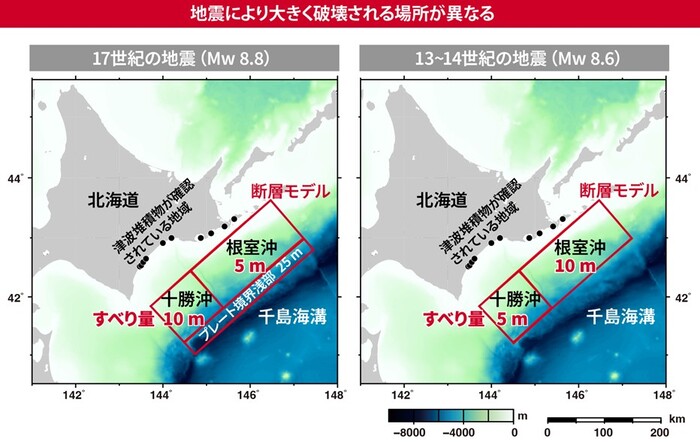
17世紀(左)と13~14世紀(右)に発生した地震の断層モデル(赤色の四角)。黒丸は津波堆積物が確認されている地域。
※原論文の図を引用・改変したものを使用しています。
<関連情報>
- https://www.aist.go.jp/aist_j/press_release/pr2026/pr20260107/pr20260107.html
- https://agupubs.onlinelibrary.wiley.com/doi/10.1029/2025GL118295
南千島海溝沿いの2つの先史時代の巨大地震の滑りパターンの違い Difference in Slip Patterns Between Two Prehistoric Giant Earthquakes Along the Southern Kuril Trench
Kei Ioki, Yuki Sawai, Yuichi Namegaya, Dan Matsumoto, Koichiro Tanigawa, Yumi Shimada, Toru Tamura, Rina Okada
Geophysical Research Letters Published: 30 December 2025
DOI:https://doi.org/10.1029/2025GL118295
Abstract
This study reveals different slip patterns of tsunami sources between two prehistoric giant earthquakes along the southern Kuril Trench, based on an integration of geological data and numerical simulations. The most recent giant earthquake occurred in the 17th century and its predecessor was in the 13th–14th century. The spatial distributions of the two associated tsunami deposits differ between the Nemuro and Tokachi regions along the Pacific coast of Hokkaido, northern Japan. We conducted detailed geological fieldwork in eastern Hokkaido to better estimate the tsunami inundation areas. These findings were then used for numerical simulations, and fault models of the 13th–14th-century earthquake (Mw 8.6–8.7) were constructed. The fault model for the 17th-century earthquake (Mw 8.8) is characterized by greater slip in the Tokachi-oki segment. In contrast, the model for the 13th–14th-century event suggests a greater slip in the Nemuro-oki segment.
Plain Language Summary
Earthquakes larger than the M8-class events have repeatedly occurred along the Kuril Trench. The most recent event occurred in the 17th century and its predecessor was in the 13th–14th century. Fieldwork was carried out to determine how far the tsunamis from these two events flooded along the eastern coast of Hokkaido. Fault models of the 13th–14th-century earthquake were developed to compare the distribution of the tsunami deposit with the computed inundation area of the tsunami. The estimated magnitudes of the 17th- and 13th–14th-century earthquakes were nearly the same, or the older event was slightly smaller than the more recent one. However, the 17th-century earthquake had a larger slip on the western part of the fault, while the 13th–14th-century earthquake had a larger slip on the eastern part.
Key Points
- The distribution of tsunami deposits along Hokkaido coast is different for 17th- and the 13th–14th-century events
- The earthquake size of the 13th–14th-century event is Mw 8.6–8.7, similar to the 17th-century event
- The 13th–14th-century event had large slip on Nemuro-oki segment, while the 17th-century event had larger slip on Tokachi-oki segment