2025-12-24 東京科学大学
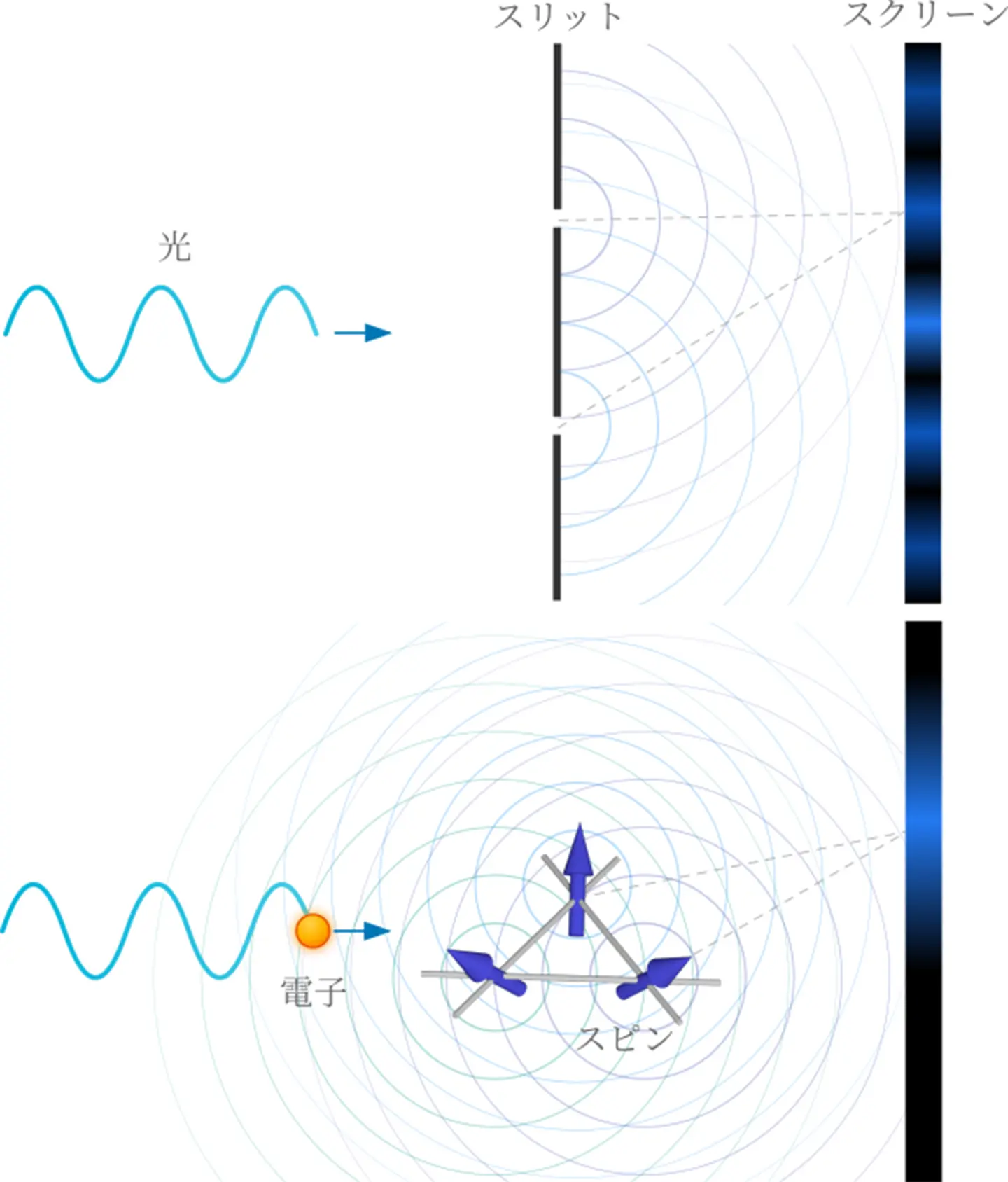
図1. 2重スリットによる光の干渉縞(上)と磁気散乱による電子波の位相干渉効果(下)。
2重スリットの実験では、それぞれのスリットを通った光の干渉により縞模様が生じる。磁気散乱では、それぞれのスピンで散乱された電子波の干渉により電子の軌道が曲がり、上方向に飛んでいく。
<関連情報>
- https://www.isct.ac.jp/ja/news/dmg4cwc4su89
- https://www.isct.ac.jp/plugins/cms/component_download_file.php?type=2&pageId=&contentsId=1&contentsDataId=2879&prevId=&key=4d368b31f8372408168b93be9b1c0f6f.pdf
- https://journals.aps.org/prl/abstract/10.1103/v97v-wpyx
高伝導性金属におけるカイラリティ関連異常ホール効果の符号反転と非単調性 Sign Reversal and Nonmonotonicity of Chirality-Related Anomalous Hall Effect in Highly Conductive Metals
Ryunosuke Terasawa, Masafumi Udagawa, and Hiroaki Ishizuka
Physical Review Letters Published: 16 December, 2025
DOI: https://doi.org/10.1103/v97v-wpyx
Abstract
The nonmonotonic temperature dependence and sign reversal of chirality-related anomalous Hall effect in highly conductive metals are studied. Through the analysis of scattering rate, we find that the nonmonotonicity and sign reversal have two major origins: (1) competition between the contribution from short-range and long-range spin correlations and (2) nonmonotonic spin correlation in the high field. The former mechanism gives rise to nonmonotonic temperature dependence in a wide range of electron density and, in some cases, a sign reversal of Hall resistivity as the temperature decreases. On the other hand, the latter mechanism is responsible for the sign reversal of Hall conductivity in the high field, which sign reversal generally occurs in magnets with antiferromagnetic interactions. The results demonstrate how the Hall effect reflects local spin correlation and provide insights into the mechanism of nonmonotonicity and sign reversal of the anomalous Hall effect by spin chirality.