2025-12-15 東京科学大学
分子吸着によるキラル電子状態の創出
<関連情報>
光学的に純粋なイオン吸着の電気的制御によるアキラル導電性界面における近接誘起キラリティー Proximity-induced chirality at the achiral conductive interface by electrical control of enantiopure ion adsorption
Po-Jung Huang, Yoshio Ando, Miuko Tanaka, Yukito Nishio, […] , and Kouji Taniguchi
Science Advances Published:21 Nov 2025
DOI:https://doi.org/10.1126/sciadv.adx2281
Abstract
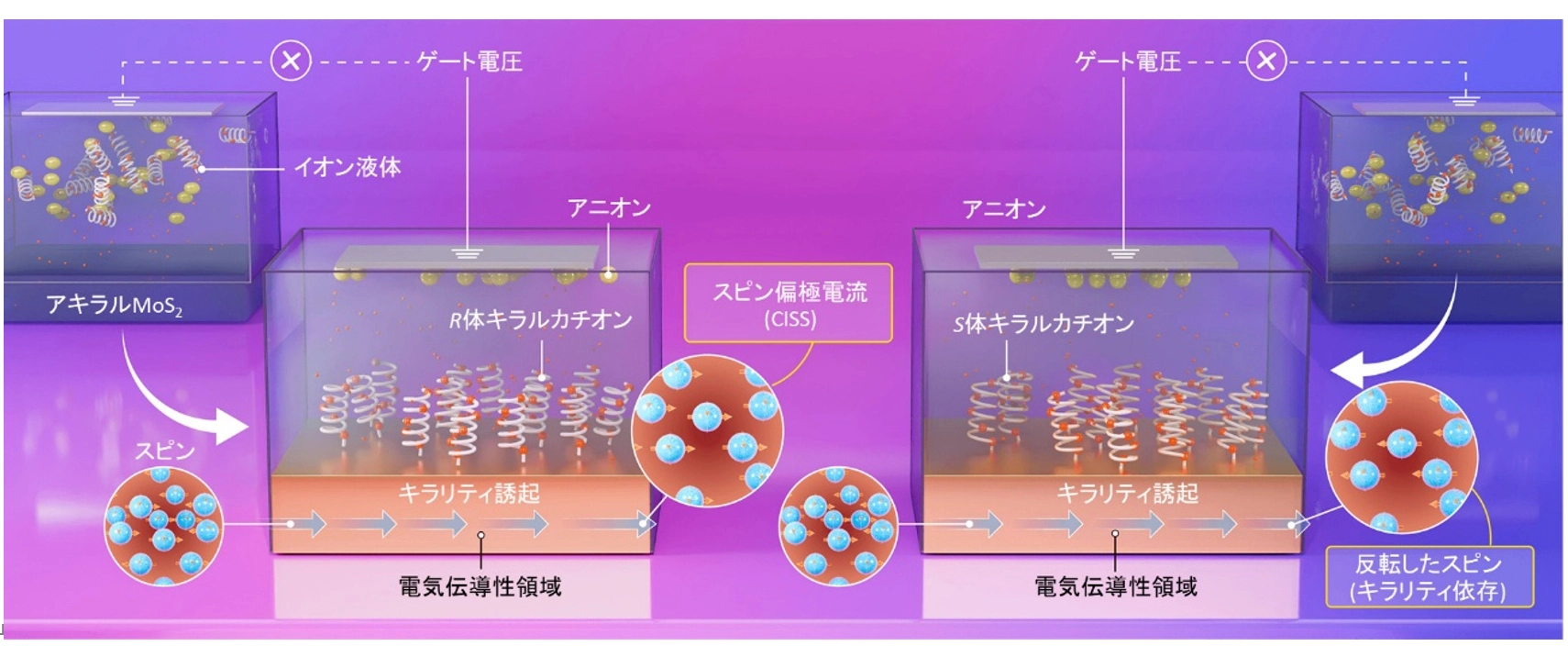
Chirality manipulation of materials has attracted substantial interest in a wide variety of fields in science and technology. Chiral molecular adsorption is a distinct approach for inducing chirality in achiral systems such as organic-inorganic hybrid compounds and nanomaterials. With the proximity effect of adsorbed chiral molecules on inorganic systems in mind, we demonstrate the artificial introduction of chirality to an achiral molybdenum disulfide surface by controlling the adsorption of enantiopure molecular cations via an electric double-layer transistor with chiral ionic liquids. In the electric field–induced conductive interface of molybdenum disulfide, the generation of chirality was confirmed by observing chirality-induced spin selectivity and electrical magnetochiral effect, which are different types of chirality-dependent charge-transport phenomena. The proximity-induced chirality realized in this study via ion-controlled electronics has the potential to advance an emergent academic field called “chiral iontronics” and expand the development of electrically controllable chirality-induced functionalities beyond this work.