2025-12-04 ペンシルベニア州立大学(PennState)
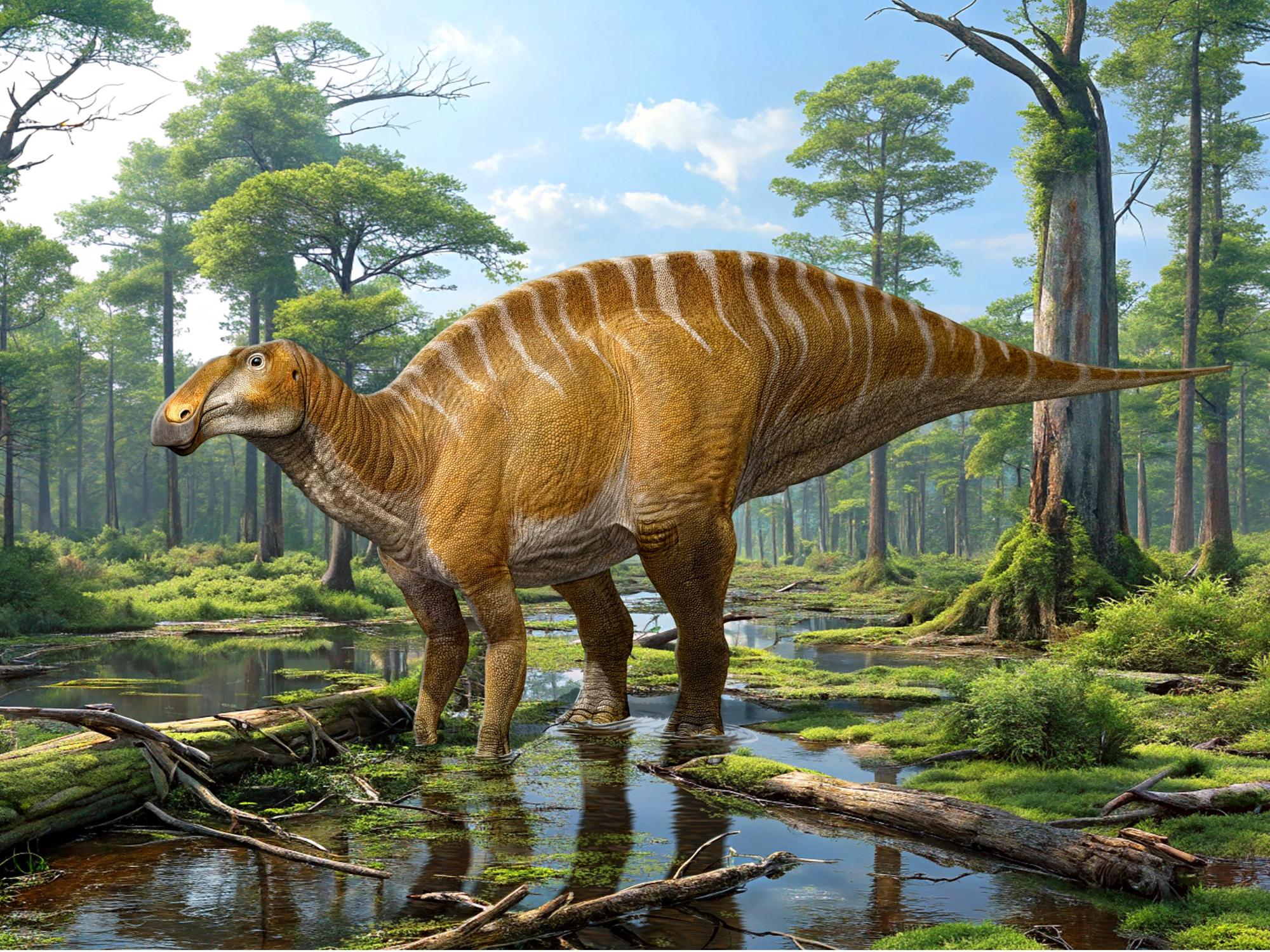
A new massive duck-billed dinosaur species has been discovered in New Mexico. A team of researchers including D. Edward Malinzak, assistant teaching professor of biology at Penn State Lehigh Valley, discovered the specimen. Credit: NMMNHS/Sergey Krasovskiy. All Rights Reserved.
<関連情報>
- https://www.psu.edu/news/lehigh-valley/story/new-massive-duck-billed-dinosaur-species-identified
- https://www.researchgate.net/publication/396005330_A_new_saurolophine_hadrosaurid_Ornithischia_Hadrosauridae_from_the_Upper_Cretaceous_Campanian_Hunter_Wash_Member_Kirtland_Formation_San_Juan_Basin_New_Mexico
ニューメキシコ州サンファン盆地、カートランド層、白亜紀後期(カンパニアン)ハンターウォッシュ層から発見された、新しい竜脚類ハドロサウルス類(鳥盤類:ハドロサウルス科) A new saurolophine hadrosaurid (Ornithischia: Hadrosauridae) from the Upper Cretaceous (Campanian) Hunter Wash Member, Kirtland Formation, San Juan Basin, New Mexico
Sebastian Dalman,Dale Edward Malinzak,Steven E. Jasinski,Spencer G. Lucas,…
ResearchGate Published:September 2025
Abstract
A new saurolophine hadrosaurid dinosaur, Ahshislesaurus wimani gen et sp. nov., from the lower Hunter Wash Member of the lower Kirtland Formation (~75.02 Ma) of New Mexico is described. The specimen was briefly described before and referred to the stratigraphically younger Kritosaurus navajovius, which is known from the De-na-zin Member (~73.83–73.49 Ma) of the uppermost Kirtland Formation. The holotype of A. wimani consists of an incomplete diagnostic skull, several isolated cranial elements including the right jugal, quadrate, dentary, and surangular, and a series of articulated cervical vertebrae. In addition to the holotype of A. wimani, several specimens from the same strata may also belong to this newly identified species, including a well-preserved left dentary and a partial skeleton, as well as two humeri, one belonging to a large adult and the other to a juvenile. The skull of A. wimani preserves several taxonomically informative characters that show close affinities with the stratigraphically younger Naashoibitosaurus ostromi from the De-na-zin Member. Together with Naashoibitosaurus, Ahshislesaurus forms a potentially novel clade of flat-headed saurolophine hadrosaurids. This clade suggests the saurolophines were a taxonomically diverse group, which, during the last 20 million years of the Cretaceous, were among the dominant herbivorous dinosaurs in southern Laramidia. Recognition of a new hadrosaurid species from New Mexico also provides further evidence for latitudinal variation in the hadrosaurid fauna during the Late Cretaceous in Laramidia.