2025-11-26 フランス国立科学研究センター(CNRS)
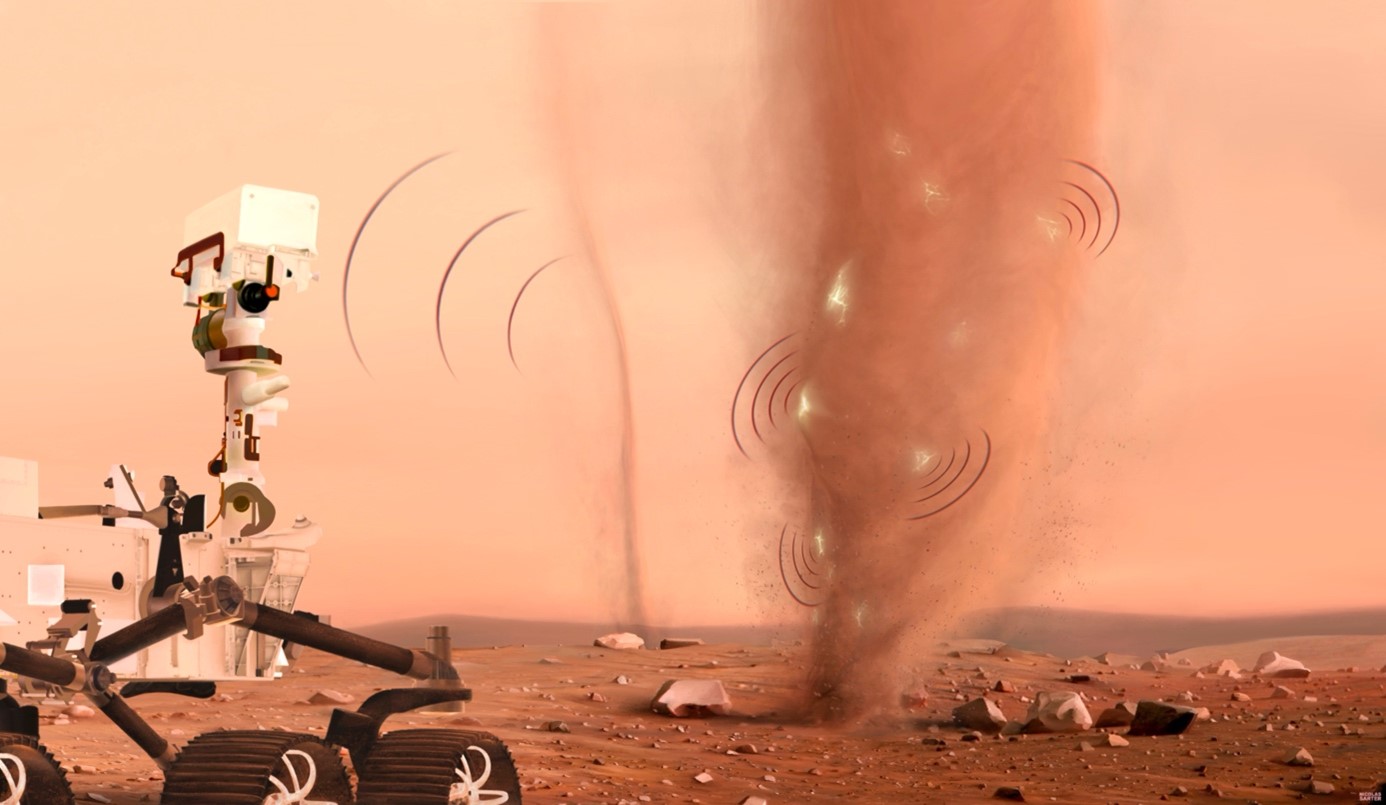
Detection of electric discharges in dust devils by the SuperCam instrument, on board the Perseverance rover on Mars.© Nicolas Sarter
<関連情報>
- https://www.cnrs.fr/en/press/electric-discharges-detected-mars-first-time
- https://www.nature.com/articles/s41586-025-09736-y
火星の塵の衝突時の摩擦電気放電の検出 Detection of triboelectric discharges during dust events on Mars
Baptiste Chide,Ralph D. Lorenz,Franck Montmessin,Sylvestre Maurice,Yann Parot,Ricardo Hueso,German Martinez,Alvaro Vicente-Retortillo,Xavier Jacob,Mark Lemmon,Bruno Dubois,Pierre-Yves Meslin,Claire Newman,Tanguy Bertrand,Grégoire Deprez,Daniel Toledo,Agustin Sánchez-Lavega,Agnès Cousin & Roger C. Wiens
Nature Published:26 November 2025
DOI:https://doi.org/10.1038/s41586-025-09736-y
Abstract
Lightning is among the most energetic manifestation of electrical activity in planetary atmospheres, with documented observations not only on Earth but also on Saturn and Jupiter1. On Mars, the existence of electrical activity has long been suspected2,3 but never directly demonstrated. The dusty atmosphere of Mars undergoes aeolian processes, ranging from wind-blown dust and sand, metre-to-hundred-metre-sized dust devils to thousand-kilometre-scale dust storms4, which, in Earth’s deserts, can become electrified through triboelectric charging5,6,7. For this reason, electric fields have been predicted to build up on Mars8,9,10, but with no measurement of Martian atmospheric electrical activity so far. Here we report in situ detections of triboelectric discharges, identified by their electrical and acoustic signatures captured by the SuperCam microphone aboard the Perseverance rover11,12. Fifty-five events have been detected over two Martian years, usually associated with dust devils and dust storm convective fronts. These serendipitous observations demonstrate that Martian electric fields can reach the breakdown threshold of the near-surface atmosphere of Mars, predicted to be on the order of several tens of kV m−1. Such electrical activity could affect dust dynamics13,14 and potentially fuel a reactive electrochemical environment enhancing the oxidizing capacity of the atmosphere, with consequences for the preservation of organic molecules15,16. This in situ evidence may have implications for surface chemistry, habitability and human exploration.