2025-11-25 中国科学院(CAS)
<関連情報>
- https://english.cas.cn/newsroom/research_news/earth/202511/t20251125_1133181.shtml
- https://www.nature.com/articles/s41550-025-02715-3
嫦娥6号着陸地点で強力な粘着力を持つ月の土壌が発見される Strongly cohesive lunar soil identified at the Chang’e-6 landing site
Shengwen Qi,Lihui Li,Xiaokun Hou,Sijia Qiao,Xiandong Ma,Xiao Lu,Jianing Cong,Ruipeng Hao,Chi Zhang,Jinhua Li,Derek Elsworth,Wei Yang,Xian-Hua Li & Fu-Yuan Wu
Nature Astronomy Published:24 November 2025
DOI:https://doi.org/10.1038/s41550-025-02715-3
Abstract
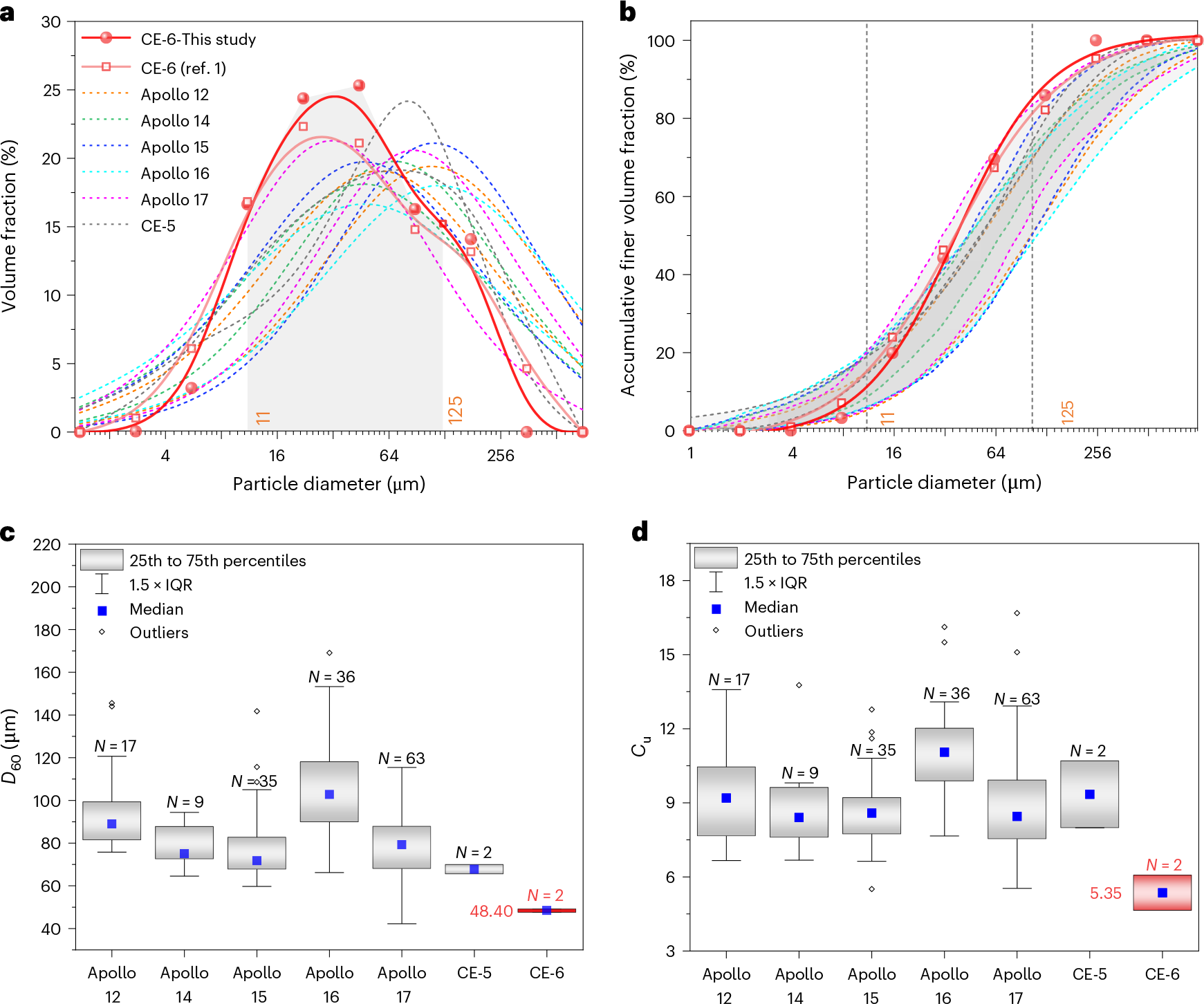
The physical properties of lunar soil are critical to understanding its evolution. However, the extent of the diversity among the global lunar soils remains unclear owing to limited sampling sites. Here we present a systematic investigation of the angle of repose (AOR), particle morphology and size distribution of soil obtained at the Chang’e-6 (CE-6) landing site, the first sample from the lunar farside. The CE-6 sample has a maximum static AOR of 52.9°, which is substantially higher than those of the Chang’e-5 and Apollo soil simulants. In addition, a substantially larger dynamic AOR of 70.4° is exhibited by the CE-6 sample compared with the CE-5 soil simulant, indicating a stronger cohesive property. This strong cohesive property can be attributed to the high plagioclase abundance and potentially strong space weathering at the sampling, especially impact reworking, which resulted in a fine particle size (D60 = 48.4 μm) of the CE-6 sample with a high portion of the intermediate fraction (that is, 11–125 μm) and a more complex morphology with a small mean sphericity (Smean = 0.58). These characteristics enhance the cohesiveness by strengthening electrostatic and van der Waals forces. This finding discloses key factors controlling the AOR and provides a fresh genesis perspective for understanding the physical properties of lunar soil, with implications for lunar evolution and future lunar resource utilization.