2025-09-04 中国科学院(CAS)
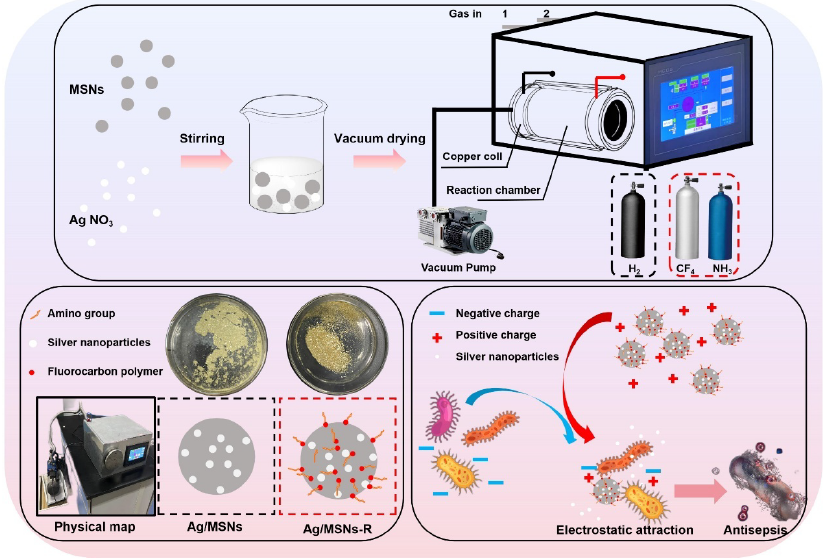
Schematic diagram of the preparation and antibacterial mechanism of Ag/SiO2-R (Image by SUN Hongmei)
<関連情報>
- https://english.hf.cas.cn/nr/rn/202509/t20250904_1053921.html
- https://www.sciencedirect.com/science/article/abs/pii/S1385894725078775
抗菌効果を高めるアミン-フルオロカーボンポリマー官能化メソポーラスシリカ担持銀ナノ粒子のプラズマ合成 Plasma synthesis of amine-fluorocarbon polymer functionalized mesoporous silica-supported silver nanoparticles for enhanced antibacterial efficacy
Jingjing Zha, Tao Sun, Ling Kong, Changqing Liu, Hongmei Sun, Dong Wang, Guohua Ni
Chemical Engineering Journal Available online: 17 August 2025
DOI:https://doi.org/10.1016/j.cej.2025.167038
Highlights
- Surface-functionalized silver/mesoporous silica composites (Ag/MSNs-R) were synthesized via plasma to modulate its surface charge.
- Ag/MSNs-R enhances antibacterial activity through electrostatic attraction to bacteria.
- Multi-omics analysis uncovers dual mechanisms of Ag/MSNs-R by bacterial metabolic suppression and tissue repair promotion.
Abstract
Mesoporous silica-supported silver nanoparticles (Ag/MSNs) have been widely utilized in therapeutic agents for skin wounds due to their excellent antibacterial properties and low cytotoxicity. However, the negative charge of the surface repels the negatively charged bacteria to reduce its antibacterial properties. Different from the conventional method, we developed a two-step plasma strategy to synthesize surface-functionalized silver/mesoporous silica composites (Ag/MSNs-R) through silver nanoparticle (Ag NPs) deposition and grafting of amine-fluorocarbon polymer. First, Ag NPs were synthesized on mesoporous silica nanoparticles (MSNs) carriers by H2 plasma reduction method. Subsequently, Ag/MSNs were modified with the mixed plasma of CF4 and NH3 to graft amine-fluorocarbon polymer (R) on their surfaces. The results indicated that Ag NPs with diameters of 6.25 ± 3.24 nm were uniformly dispersed in MSNs. Meanwhile, Ag/MSNs modified with R displayed a positive charge, attracting the negatively charged bacterial cell membranes due to electrostatic interaction. In vitro antibacterial assays showed that Ag/MSNs-R achieved more than 98 % reduction in bacterial viability against both Gram-positive (S. aureus) and Gram-negative (E. coli) pathogens, outperforming the antibacterial performance of Ag/MSNs by 7.4-fold and 4.37-fold. In vivo studies demonstrated that Ag/MSNs-R exhibited antibacterial properties against E. coli pathogens, reduced inflammation caused by bacterial infections, and accelerated the wound healing process through the Arginase-1 signaling pathway. The experiment provided a new method for grafting functional groups onto silica.