2025-11-21 分子科学研究所
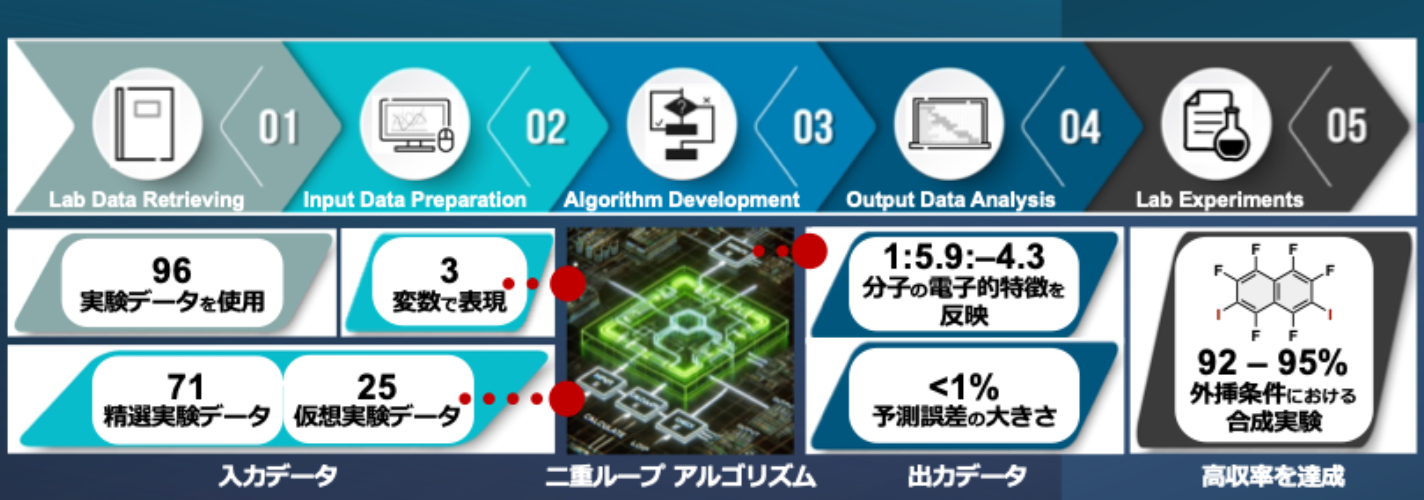
図:本研究で開発した「潜在変数」を用いたAIによる有機合成の新しいワークフロー
(掲載論文のグラフィカルアブストラクトより改変・引用)
<関連情報>
- https://www.ims.ac.jp/news/2025/11/1121.html
- https://www.sciencedirect.com/science/article/pii/S2949747725000132
機械学習による将来有望な有機分子材料の合成:実験では観測できない反応を理解し予測するための潜在変数を備えたアルゴリズム Machine learning-guided synthesis of prospective organic molecular materials: An algorithm with latent variables for understanding and predicting experimentally unobservable reactions
Kazuhiro Takeda, Naoya Ohtsuka, Toshiyasu Suzuki, Norie Momiyama
Artificial Intelligence Chemistry Available online: 13 October 2025
DOI:https://doi.org/10.1016/j.aichem.2025.100096
Highlights
- ML algorithm predicts unobservable reactions using latent variables.
- Latent variables correlate with NBO charges, rationalizing reaction mechanisms.
- High prediction accuracy achieved with RMSE < 1 % in extrapolation domain.
- Experimental validation confirms accurate reaction yield predictions.
- Potential applications in catalysts, semiconductors, and biosensors.
Abstract
Chemists have traditionally relied on heuristic approaches to qualitatively assess chemical structure–property relationships and interpret experimental outcomes. However, these methods are inherently limited in handling large volumes of data and integrating them effectively into experimental planning. Understanding the interrelationships among different substitution patterns of organic molecular materials is crucial for optimizing synthetic conditions and expanding their applicability. In this study, we developed a machine learning (ML) algorithm incorporating latent variables to predict unobservable reactions and synthetic conditions for organic materials, specifically perfluoro-iodinated naphthalene derivatives. The algorithm accurately estimated substitution pattern relationships and reaction yields, which were experimentally validated with high-yield outcomes. Our findings reveal that latent variables effectively capture underlying physicochemical relationships, achieving an R value > 0.99. This approach establishes an ML-guided framework that complements heuristic decision-making in chemistry and optimizes synthetic processes for the target molecule in an extrapolative manner. Further applications of this algorithm will focus on synthetic design and physicochemical property prediction, particularly for catalyst discovery and organic semiconductor optimization.