2025-11-19 中国科学院(CAS)
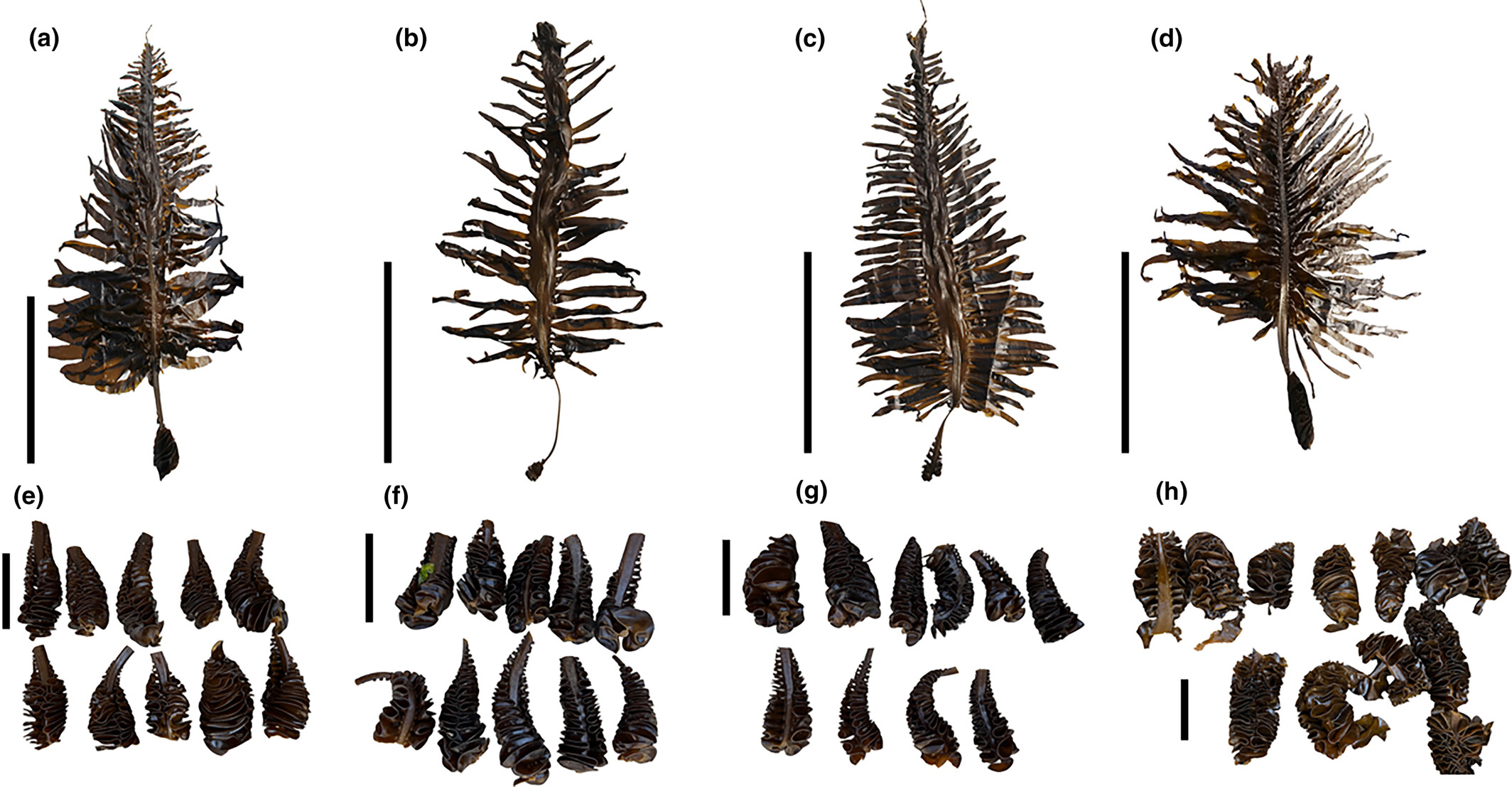
Triploid sporophytes of Undaria pinnatifida (a,b,c) and their sporophylls (e,f,g) and their diploid counterparts (d, h). (Image by IOCAS)
<関連情報>
- https://english.cas.cn/newsroom/research-news/202602/t20260210_1150475.shtml
- https://onlinelibrary.wiley.com/doi/10.1111/jpy.70107
倍加した半数体胞子体由来の無胞子性配偶体と半数体配偶体の交配による三倍体ワカメの育種 Breeding of triploid Undaria pinnatifida through crossing aposporous gametophytes derived from doubled haploid sporophytes with haploid gametophytes
Tifeng Shan, Yuqian Li
Journal of Phycology Published: 15 November 2025
DOI:https://doi.org/10.1111/jpy.70107
Abstract
Undaria pinnatifida is an economically important kelp that is extensively farmed in East Asia. Increasingly severe ocean warming makes it urgent to breed new cultivars that are resistant to higher temperatures. Breeding of triploid sporophytes is a potential way to achieve this purpose. Diploid gametophytes were previously produced via apospory from heterozygous sporophytes; however, their sex was not pure, making it difficult to conduct a precise cross. In the present study, we addressed this issue by means of obtaining aposporous diploid gametophytes from doubled haploid sporophytes that were produced by self-fertilization of a monoicous gametophyte. The sex of the aposporous diploid gametophytes was determined to be male. We crossed the male diploid gametophytes with three female haploid gametophyte clonal lines and obtained three hybrid sporophyte lines, which were identified to be triploid using flow cytometry analysis. We cultivated the three triploid lines in the open sea and evaluated their economic traits in April. Their total length and blade length were significantly higher than the control cultivar despite their cultivation period being ~2 months shorter than that of the control. Obvious decay was observed in the control, but not in the triploid sporophytes, suggesting that they sustained growth in higher temperatures. The triploid sporophytes formed sporophylls but were not able to release spores in the reproductive season, and thus, they were determined to be sterile. This study provides a novel and precise means for breeding triploid sporophytes in U. pinnatifida, which is expected to be useful for breeding triploid cultivars superior to the current diploid cultivars.