2025-11-13 奈良先端科学技術大学院大学,科学技術振興機構,京都府立大学,名古屋大学,広島大学
<関連情報>
- https://www.jst.go.jp/pr/announce/20251113/index.html
- https://www.jst.go.jp/pr/announce/20251113/pdf/20251113.pdf
- https://www.nature.com/articles/s41467-025-65792-y
EPFL2とオーキシンの相互阻害は周期的な葉の形態形成の間隔を延長する Mutual inhibition between EPFL2 and auxin extends the intervals of periodic leaf morphogenesis
Toshiaki Tameshige,Takeshi Tsuchida,Yuuki Matsushita,Yuki Doll,Kaisei Maruyama,Takemoto Agui,Mitsuhiro Aida,Hiroyuki Kasahara,Keiko U. Torii,Naoyuki Uchida,Koichi Fujimoto & Momoko Ikeuchi
Nature Communications Published:13 November 2025
DOI:https://doi.org/10.1038/s41467-025-65792-y
Abstract
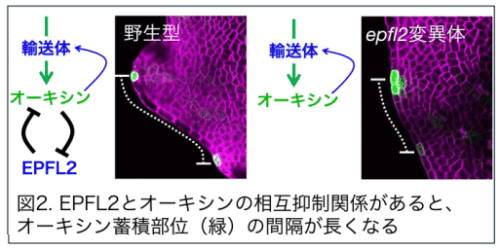
Rules behind the spatial arrangement of repetitive modules are key principles of multicellular morphogenesis. In plant shoots, PIN-FORMED 1 (PIN1)-mediated polar auxin transport instructs periodic formation of auxin maxima, which develop into lateral organs or leaf serrations. However, it remains unknown how the intervals of regularly arising auxin maxima are controlled. Here we show that a cysteine rich peptide EPIDERMAL PATTERNING FACTOR-LIKE 2 (EPFL2) dose-dependently determines the intervals of auxin maxima during serration formation in leaf primordia. EPFL2 constitutes a mutually repressive relationship with cellular auxin response, thereby produces bistable states. Based on our computational simulations, we propose that the bistability modulates the periodicity of PIN1-mediated auxin maxima formation. Moreover, EPFL2 ensures precise phyllotactic angles, underscoring the general role of EPFL2 in auxin-mediated shoot patterning. This study illustrates that the intercoupling between EPFL2-auxin bistable module and PIN1-mediated polar auxin transport underpins versatile periodicity in auxin maxima formation during shoot development.