2025-11-06 ニューヨーク大学(NYU)
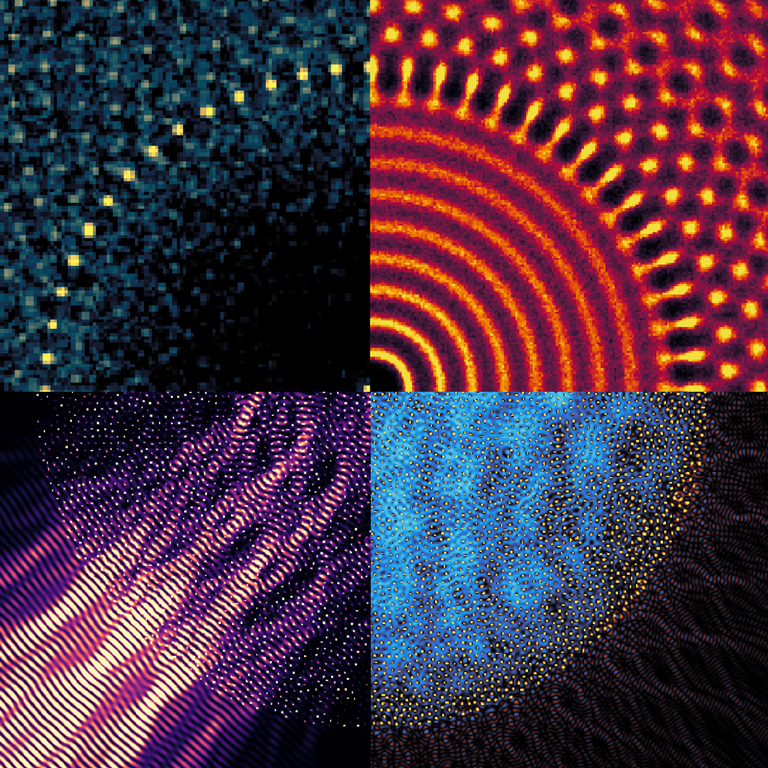
Illustration of a 60-fold gyromorph’s properties. Top row: Structure of the gyromorph. Left: Structure factor. Right: Pair correlation function. Bottom row: Optical properties. Left: Polarized light beam fully reflected by a gyromorph. Right: Density of states depletion in the gyromorph. Image by the Martiniani lab at NYU
<関連情報>
- https://www.nyu.edu/about/news-publications/news/2025/november/scientists-discover-breakthrough-materials-to-enhance-light-base.html
- https://journals.aps.org/prl/abstract/10.1103/gqrx-7mn2
ジャイロモルフ:新しい種類の機能性無秩序物質 Gyromorphs: A New Class of Functional Disordered Materials
Mathias Casiulis, Aaron Shih, and Stefano Martiniani
Physical Review Letters Published: 6 November, 2025
DOI: https://doi.org/10.1103/gqrx-7mn2
Abstract
We introduce a new class of functional correlated disordered materials, termed gyromorphs, which uniquely combine liquidlike translational disorder with quasi-long-range rotational order, induced by a ring of delta peaks in their structure factor. We generate gyromorphs in 2D and 3D by spectral optimization methods, verifying that they display strong discrete rotational order but no long-range translational order, while maintaining rotational isotropy at short range for sufficiently large . Using a coupled dipoles approximation, we numerically show that these structures outperform quasicrystals, stealthy hyperuniformity, and Vogel spirals in the formation of low-index-contrast isotropic band gaps in 2D, for both scalar and vector waves, and open complete isotropic band gaps in 3D. This claim is further supported by analytical effective-medium theory and by numerical estimates of scattering mean-free paths. Finally, we introduce “polygyromorphs” with several rotational symmetries at different length scales (i.e., multiple rings of delta peaks), enabling the formation of multiple band gaps in a single structure, thereby paving the way for fine control over optical properties.