2025-11-06 総合研究大学院大学
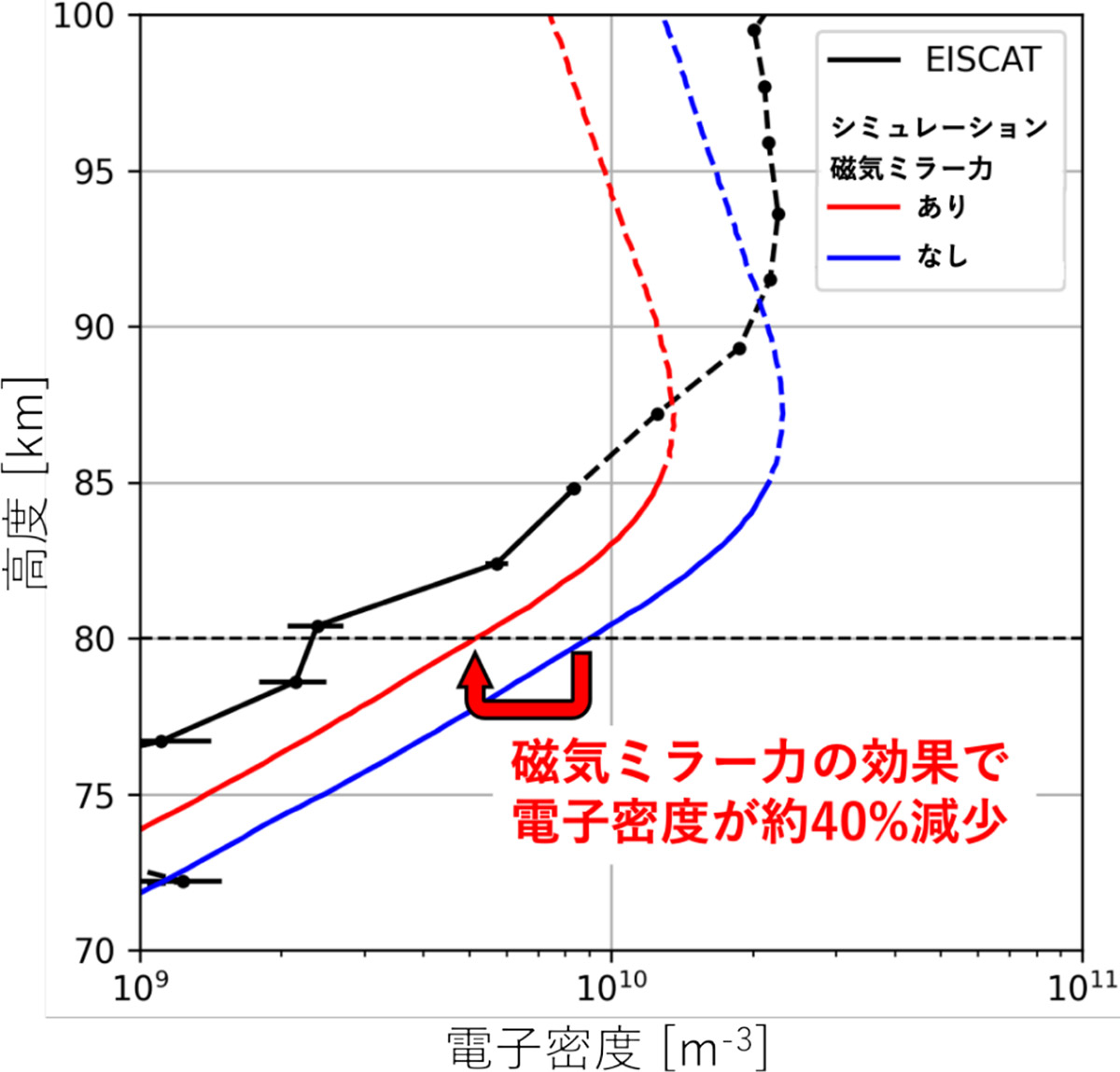 図1:世界時2021年12月16日07時14分頃における電子密度高度分布の比較。黒はEISCATレーダーによる観測結果。赤と青はシミュレーション結果で、それぞれ磁気ミラー力を考慮した場合と考慮しなかった場合を示す。磁気ミラー力を取り入れることで高度80 kmにおける電子密度が約40%減少した。また、EISCATレーダーによる同時観測結果は、磁気ミラー力を考慮したものにより近かった。
<関連情報>
- https://www.soken.ac.jp/news/2025/20251106_1.html
- https://angeo.copernicus.org/articles/43/621/2025/
地磁気ミラー力と降下電子のピッチ角が極域上層大気の電離に与える影響 Effects of geomagnetic mirror force and pitch angles of precipitating electrons on ionization of the polar upper atmosphere
Tomotaka M. Tanaka, Yasunobu Ogawa, Yuto Katoh, Mizuki Fukizawa, Anton Artemyev, Vassilis Angelopoulos, Xiao-Jia Zhang, Yoshimasa Tanaka, and Akira Kadokura
Annales Geophysicae Published:20 Oct 2025
DOI:https://doi.org/10.5194/angeo-43-621-2025
Abstract
We studied the effects of the geomagnetic mirror force on electron density enhancements in the polar atmosphere due to energetic electron precipitation. Using the pitch angle and energy distribution of electrons observed by the low-altitude Electron Losses and Fields INvestigation (ELFIN) satellites as initial conditions, the electron density in the atmosphere caused by precipitating electrons was calculated using a simulation with two different methods: a traditional method that does not include the effect of the mirror force and a recently developed method that includes the effect. From a simultaneous observation event of the ELFIN satellite and the European Incoherent SCATter scientific radar system (EISCAT) Tromsø radar, it was found that the method with the effect of the mirror force reduces electron density by about 40 % at an altitude of 80 km compared to the traditional method. This decrease was pronounced when the pitch angle distribution of high-energy electrons was concentrated in the pitch angle range of the trapped component and near the loss cone. The maximum decrease was 50 %. For an event where the altitude profile of electron density was accurately determined from the EISCAT radar, the electron density profile estimated using the method with the effect of mirror force showed better agreement with the electron density profile derived from the EISCAT radar. The comparison between simulation results and the observation data contributes to the establishment and improvement of atmospheric ionization models using various types of precipitating electrons.