2025-11-05 ロードアイランド大学(URI)
<関連情報>
- https://www.uri.edu/news/2025/11/uri-climate-scientist-contributes-to-research-illustrating-future-impacts-of-antarctic-ice-sheet-melting/
- https://www.nature.com/articles/s41467-025-64438-3
- https://agupubs.onlinelibrary.wiley.com/doi/full/10.1029/2022EF002940
南極の融雪水は気候と海面の将来の予測を変える Antarctic meltwater alters future projections of climate and sea level
Shaina Sadai,Ambarish V. Karmalkar,David Pollard,Yue Dong,Erica Lucas,Natalya Gomez,Robert DeConto & Alan Condron
Nature Communications Published:29 October 2025
DOI:https://doi.org/10.1038/s41467-025-64438-3
Abstract
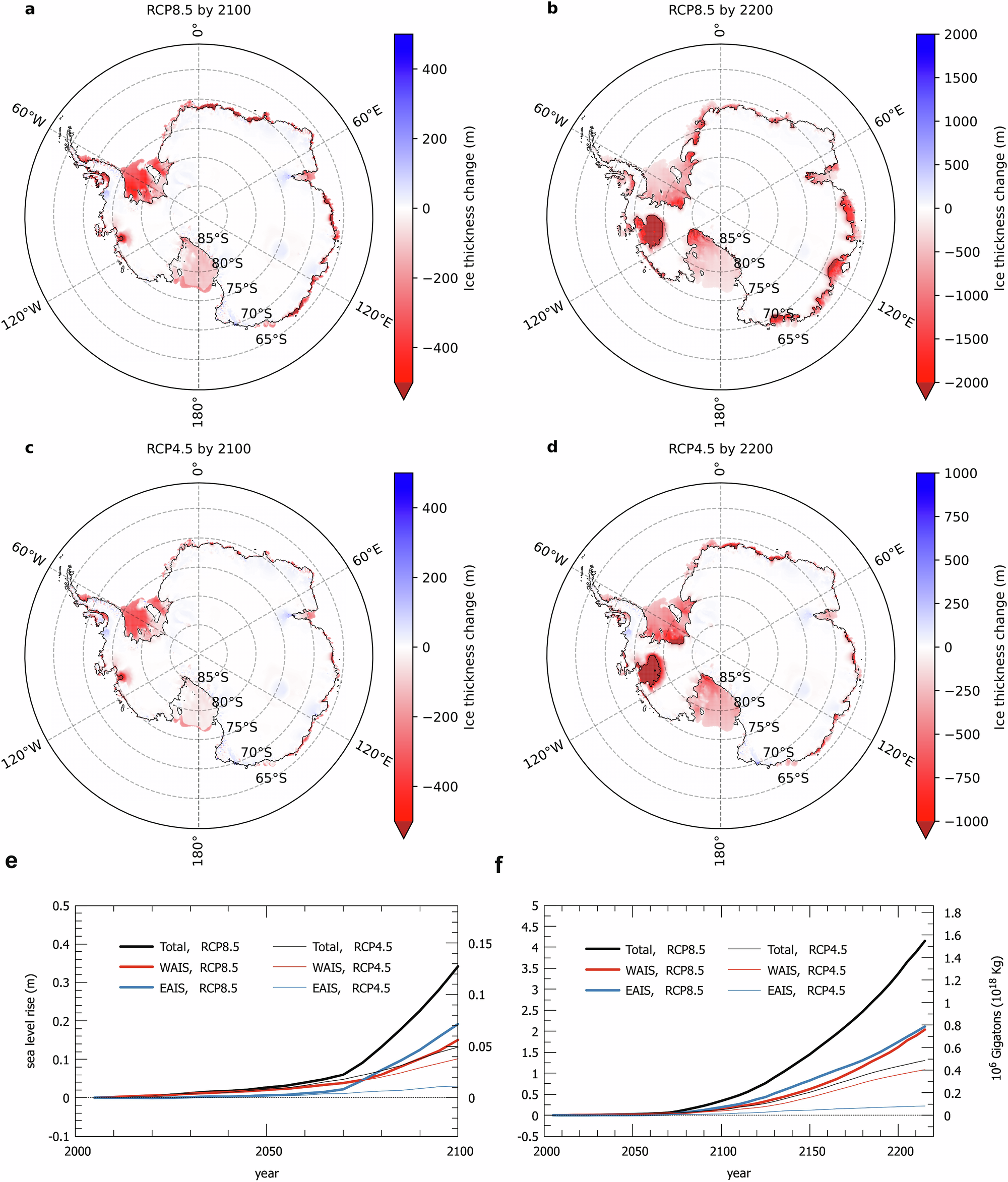
Imperfect understanding of ice sheet-climate interactions poses challenges for projecting the impacts of ice sheet mass loss on future climate and sea level. Here we couple a dynamic Antarctic ice sheet model and global climate model to simulate ice sheet-climate interactions. In our single-model, single-member modeling framework, we find sea level and climate projections are significantly modified from uncoupled simulations neglecting Antarctic meltwater under RCP8.5 and RCP4.5. Antarctic meltwater yields surface air temperatures up to 1.5 °C higher in parts of the Northern Hemisphere, while broadly dampening temperature rise in the Southern Hemisphere. Due to radiative feedback changes, both emissions scenarios have global mean surface temperature warming ~0.3 °C lower in the coupled scenario than the control by 2100, with a maximum anomaly of ~1 °C at 2200 under RCP8.5. This slows Antarctica’s contribution to global mean sea level rise. Total Antarctic sea level contributions under RCP8.5 (2100: ~0.3 m, 2200: >3 m) include substantial contributions from East Antarctica, though not under RCP4.5 (2100: ~0.1 m, 2200: >1 m). Regionally, projected sea level is up to 0.9 m higher in the Pacific than the global mean Antarctic contribution under RCP8.5 at 2200.
パリ協定と気候正義:気温目標に関連する海面上昇の不公平な影響 The Paris Agreement and Climate Justice: Inequitable Impacts of Sea Level Rise Associated With Temperature Targets
S. Sadai, R. A. Spector, R. DeConto, N. Gomez
Earth’s Future Published: 09 November 2022
DOI:https://doi.org/10.1029/2022EF002940
Abstract
Anthropogenic greenhouse gas emissions are causing unprecedented changes to the climate. In 2015, at the United Nations (UN) Conference of the Parties in Paris, France, countries agreed to limit the global mean temperature (GMT) increase to 2°C above preindustrial levels, and to pursue efforts to limit warming to 1.5°C. Due to the long-term irreversibility of sea level rise (SLR), risks to island and coastal populations are not well encapsulated by the goal of limiting GMT warming by 2100. This review article investigates the climate justice implications of temperature targets in light of our increasing understanding of the spatially variable impact and long temporal commitment to rising seas. In particular we highlight the impact that SLR will have on island states and the role of the Alliance of Small Island States (AOSIS) in UN climate negotiations. As a case study we review dual impacts from the Antarctic Ice Sheet under a changing climate: (a) recent climate and ice sheet modeling shows that Antarctic melt has the potential to cause rapid SLR with a distinct spatial pattern leading to AOSIS nations experiencing SLR at least 11% higher than the global average and up to 33% higher; and (b) future ice sheet melt will result in a negative feedback on GMT, thus delaying temperature rise. When considering these impacts in conjunction, justice concerns associated with the Paris Agreement are exacerbated.
Plain Language Summary
At the Paris Climate Agreement in 2015, countries adopted a target for stabilizing climate change defined by how the rise in global average air temperature has increased relative to a pre-industrial baseline (1850–1900). Prior research has identified numerous climate justice implications associated with this approach. This study reviews climate justice issues associated with Paris Agreement temperature targets, finding that using air temperature by 2100 as the main metric does not adequately capture other climate risks, particularly sea level rise (SLR) faced by island and coastal communities. We introduce a new climate justice consideration based on the simultaneous impacts of SLR and slowed warming caused by ice loss on Antarctica. Slowed warming might appear to delay the need for climate action, but a focus on end-of-century temperature misses the impacts of long-term accelerating SLR.
Key Points
- This review considers the Paris Agreement temperature target in the context of long-term, spatially variable sea level rise
- We interpret reviewed literature through theories of climate justice, assessing impact to members of the Alliance of Small Island States
- Modeling of Antarctic melt indicates sea levels rise while temperature increase slows, complicating use of temperature targets post-2100