
2025-10-31 中国科学院(CAS)
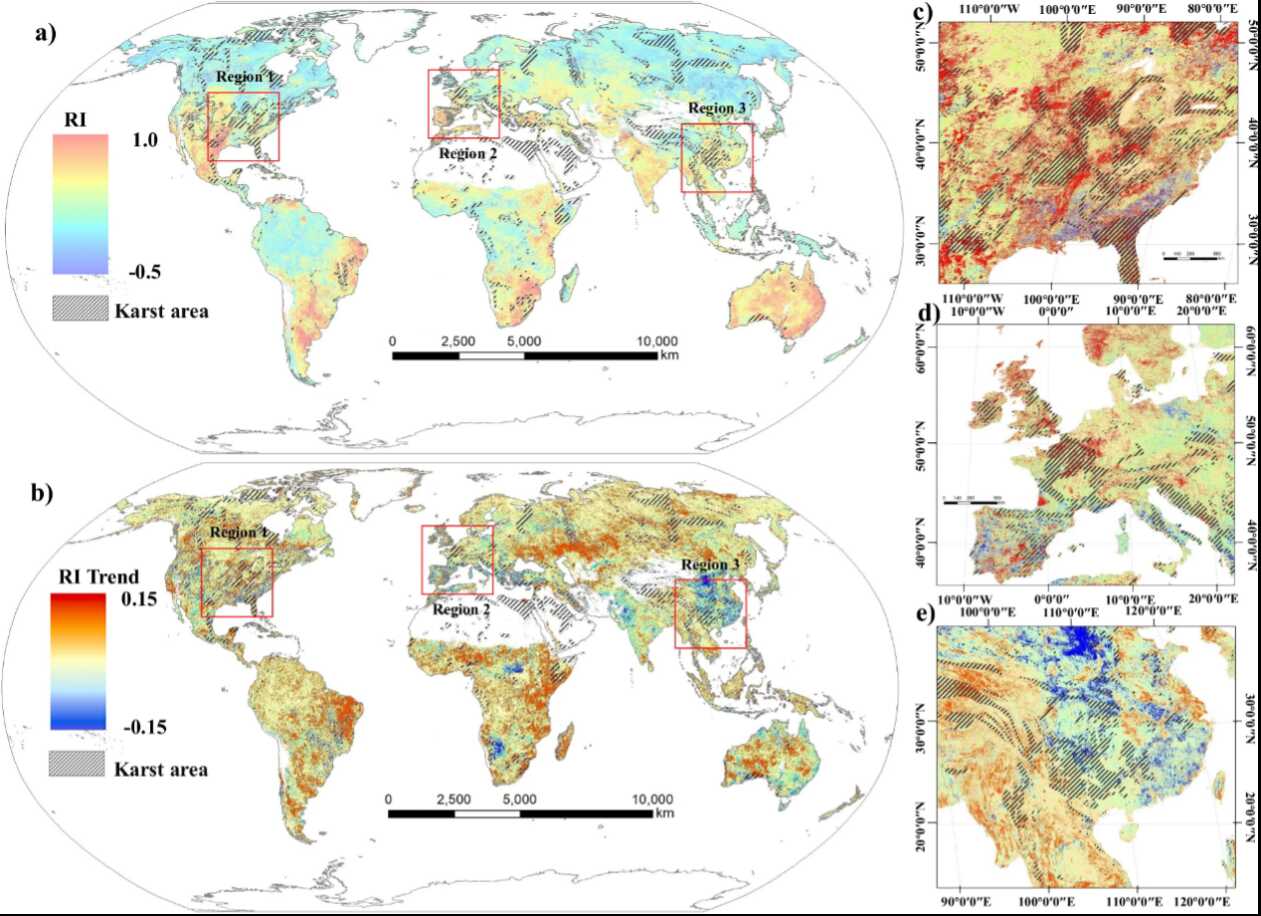
Spatial heterogeneity of global vegetation drought adaptation. (Image by AIR)
<関連情報>
- https://english.cas.cn/newsroom/research_news/earth/202510/t20251031_1095230.shtml
- https://www.nature.com/articles/s41612-025-01223-5
世界のカルスト地域における植生の干ばつ適応性の違い Differential vegetation drought adaptability in global karst areas
Yuanhuizi He,Li Wang,Jie Pei,Shidong Liu,Hui Yang,Jianhua Cao,Wang Li,Zheng Niu,Ni Huang,Xiyan Xu,Jianping Duan,Biswajit Nath,Shengping Ding & Fang Chen
npj Climate and Atmospheric Science Published16 October 2025
DOIhttps://doi.org/10.1038/s41612-025-01223-5
Abstract
Karst vegetation ecosystems are highly sensitive to climate change. However, relative to the other vegetation ecosystems, the adaptability of the vulnerable vegetation in the karst ecosystem to drought events remains unclear, especially in quantifying the contribution of different factors, including forest age, canopy height, terrain slope, precipitation, and human population. Here, we developed an evaluation framework based on a vegetation response intensity (RI), which includes drought stress windows and delayed vegetation response windows to detect vegetation adaptability to drought stress. Results show that the vegetation adaptability in global karst areas shows an increasing trend (-0.06 yr-1, p < 0.01), but shows significant differences. Although vegetation in all karst regions shows weak adaptability to short-term sudden droughts, vegetation adaptability in Europe (RI = 0.05) and North America (RI = 0.10) is significantly stronger than that in southwest China (RI = 0.23) for long-term drought. Notably, although the ecological restoration process can rapidly increase greenery in sensitive and fragile karst areas, the artificially restored vegetation with a lower age lacks adaptability to drought events in the short term. The adaptability of vegetation in karst areas to drought is mainly influenced by forest age (improved: 16.67%), slope (degraded: 18.87%), precipitation (degraded: 32.27%), and population (degraded: 31.22%) disturbance. Ecosystems with more complete ecological succession and longer duration exhibit strong adaptability to drought.


