
2025-10-16 ジョージア工科大学(Georgia Tech)
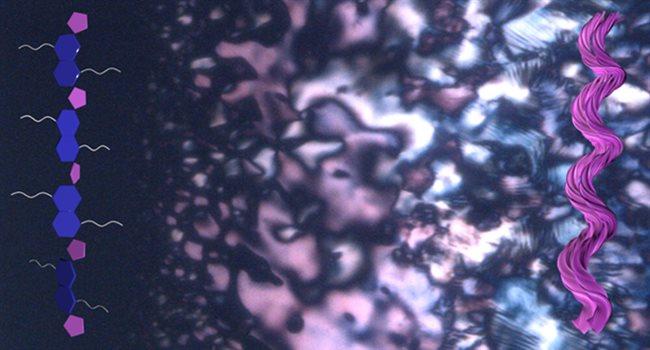
Certain materials can spontaneously form spiral-shaped structures, even when they start out without any ‘handedness.’ These tiny helices emerge during a phase separation process, offering clues about how life’s building blocks may have first developed a preference for one ‘handed’ form over another. (Credit: Jong-Hoon Lee, Ziming Wang, Ying Diao)
<関連情報>
- https://research.gatech.edu/researchers-discover-spontaneous-chirality-conjugated-polymers
- https://pubs.acs.org/doi/abs/10.1021/jacs.5c07995
液液相分離による共役高分子の普遍的なキラル対称性の破れ Ubiquitous Chiral Symmetry Breaking of Conjugated Polymers via Liquid–Liquid Phase Separation
Zhuang Xu,Ziming Wang,Rui Zhang,Archana Verma,Justin S. Neu,Priyotosh Bairagya,Sanghyun Jeon,Alec M. Damron,Joshua M. Rinehart,Justine S. Wagner,Sina Sabury,Xuyi Luo,Anna M. Österholm,Jianguo Mei,Jeffrey S. Moore,Wei You,John R. Reynolds,Nicholas E. Jackson,and Ying Diao
Journal of the American Chemical Society Published: September 8, 2025
DOI:https://doi.org/10.1021/jacs.5c07995
Abstract
Spontaneous chiral symmetry breaking remains a fascination in chemistry, biology, materials science, and even astronomy. Chiral symmetry breaking usually requires intrinsic molecular chirality or extrinsic chiral sources but remains rare in nonchiral systems. Here, we reveal a ubiquitous, entropy-driven chiral symmetry breaking mechanism observed in 22 out of 35 conjugated polymers in the absence of any chiral source─a phenomenon overlooked for decades. Chiral assemblies spontaneously occur through liquid–liquid phase separation (LLPS) of lyotropic mesophases from isotropic solutions upon a concentration increase. Machine learning identifies the underpinning molecular features validated by further molecular design. The universality of this phenomenon hints at a possible link between LLPS and chiral symmetry breaking in the origin of life, while paving the way for an emerging frontier of chiral electronics.


