2025-09-18 ラトガース大学
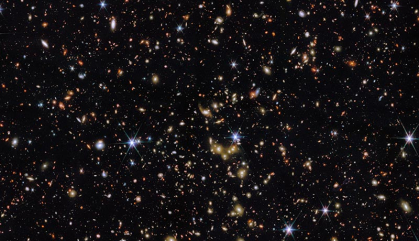
The researchers focused on data taken from a region of the sky known as the Cosmic Evolution Survey Deep Field (COSMOS), in one of the largest deep-sky surveys ever conducted.
ESA/Webb, NASA & CSA, G. Gozaliasl, A. Koekemoer, M. Franco, and the COSMOS-Web team
<関連情報>
- https://www.rutgers.edu/news/galaxies-reveal-hidden-maps-dark-matter-early-universe
- https://iopscience.iop.org/article/10.3847/2041-8213/adec82
ODIN: z = 2.4、3.1、4.5における 14,000 Ly α放射銀河のクラスタリング解析 ODIN: Clustering Analysis of 14,000 Lyα-emitting Galaxies at z = 2.4, 3.1, and 4.5
Danisbel Herrera, Eric Gawiser, Barbara Benda, Nicole M. Firestone, Vandana Ramakrishnan, Byeongha Moon, Kyoung-Soo Lee, Changbom Park, Francisco Valdes, Yujin Yang,…
The Astrophysical Journal Letters Published: 2025 July 28
DOI:10.3847/2041-8213/adec82
Abstract
Lyα emitters (LAEs) are star-forming galaxies that efficiently probe the spatial distribution of galaxies in the high-redshift Universe. The spatial clustering of LAEs reflects the properties of their individual host dark matter halos, allowing us to study the evolution of the galaxy–halo connection. We analyze the clustering of 5233, 5220, and 3706 LAEs at z = 2.4, 3.1, and 4.5, respectively, in the 9 deg2 COSMOS field from the One-hundred-deg2 DECam Imaging in Narrowbands survey. After correcting for redshift-space distortions, LAE contamination rates, and the integral constraint, the observed angular correlation functions imply linear galaxy bias factors of b =1.72+0.26–0.27,2.01+0.26-0.29, and 2.95+0.40– 0.46 for z = 2.4, 3.1, and 4.5, respectively. The median dark matter halo masses inferred from these measurements are log(Mh/M⦿) =11.44+3.0-0.28,11.13+0.26-0.26,and 10.85+0.24-0.24 for the three samples, respectively. The analysis also reveals that LAEs occupy roughly 3%–7% of the halos whose clustering strength matches that of the LAEs.