2025-10-06 物質・材料研究機構),東京大学,産業技術総合研究所,大阪大学,東北大学,科学技術振興機構
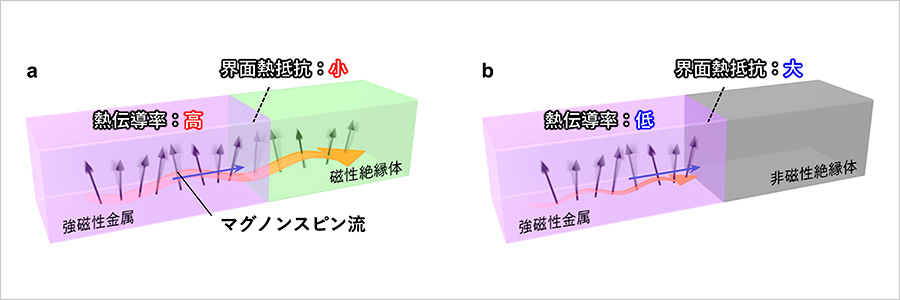
図: 強磁性金属/磁性絶縁体(a)と強磁性金属/非磁性絶縁体(b)接合におけるマグノンによる熱伝導制御の概念図。
マグノンが界面透過できる際には透過できないときに比べて強磁性金属の熱伝導率が上昇、界面熱抵抗が低下する。
<関連情報>
- https://www.nims.go.jp/press/2025/10/202510060.html
- https://www.nims.go.jp/press/2025/10/hpei2l0000004h5t-att/202510060.pdf
- https://advanced.onlinelibrary.wiley.com/doi/10.1002/adfm.202506554
非平衡マグノンエンジニアリングによる大幅な熱輸送変調 Non-Equilibrium Magnon Engineering Enabling Significant Thermal Transport Modulation
Takamasa Hirai, Toshiaki Morita, Subrata Biswas, Jun Uzuhashi, Takashi Yagi, Yuichiro Yamashita, Varun Kumar Kushwaha, Fuya Makino, Rajkumar Modak, Yuya Sakuraba, Tadakatsu Ohkubo, Rulei Guo, Bin Xu, Junichiro Shiomi, Daichi Chiba, Ken-ichi Uchida …
Advanced Functional Materials First published: 01 October 2025
DOI:https://doi.org/10.1002/adfm.202506554
Abstract
Thermal conductivity, a fundamental parameter characterizing thermal transport in solids, is typically determined by electron and phonon transport. Although electrical transport properties are material-specific, recent advance in understanding phonon transport has led to new insights on controlling the thermal conductivity via phonon engineering techniques. Here, an unconventional way of artificially modulating the heat conduction in solids is demonstrated via engineering of magnon transport. Time-domain thermoreflectance measurements in ferromagnetic metal/insulator junction systems reveal that the thermal conductivity of the ferromagnetic metals and interfacial thermal conductance vary substantially depending on the spatial distribution of non-equilibrium spin currents. Systematic measurements of the thermal transport properties with changing the boundary conditions for spin currents unveil that magnons significantly modulate the heat conduction by ≈10 W m−1 K−1 even in ferromagnetic metals at room temperature, upsetting the conventional wisdom that the magnon thermal conductivity is very small in metals except at low temperatures. This magnon-engineered thermal transport offers a new principle and manner for active thermal management.