2025-09-19 中国科学院(CAS)
中国科学院武漢植物園の研究チームは、湿地生態系における植物多様性が窒素循環に大きな影響を与えることを明らかにしました。多様性が高いほど土壌中の窒素や溶存有機炭素(DOC)が増加し、硝酸塩濃度が低下。特に脱窒が主要経路となり、窒素除去能力が向上しました。種数や機能群よりも系統多様性が強力な予測因子であり、植物の生活史段階も炭素動態や遺伝子群に作用して循環速度を左右しました。本成果は湿地修復や生物多様性保全、窒素汚染対策に理論的基盤を提供するもので、「New Phytologist」誌に掲載されました。
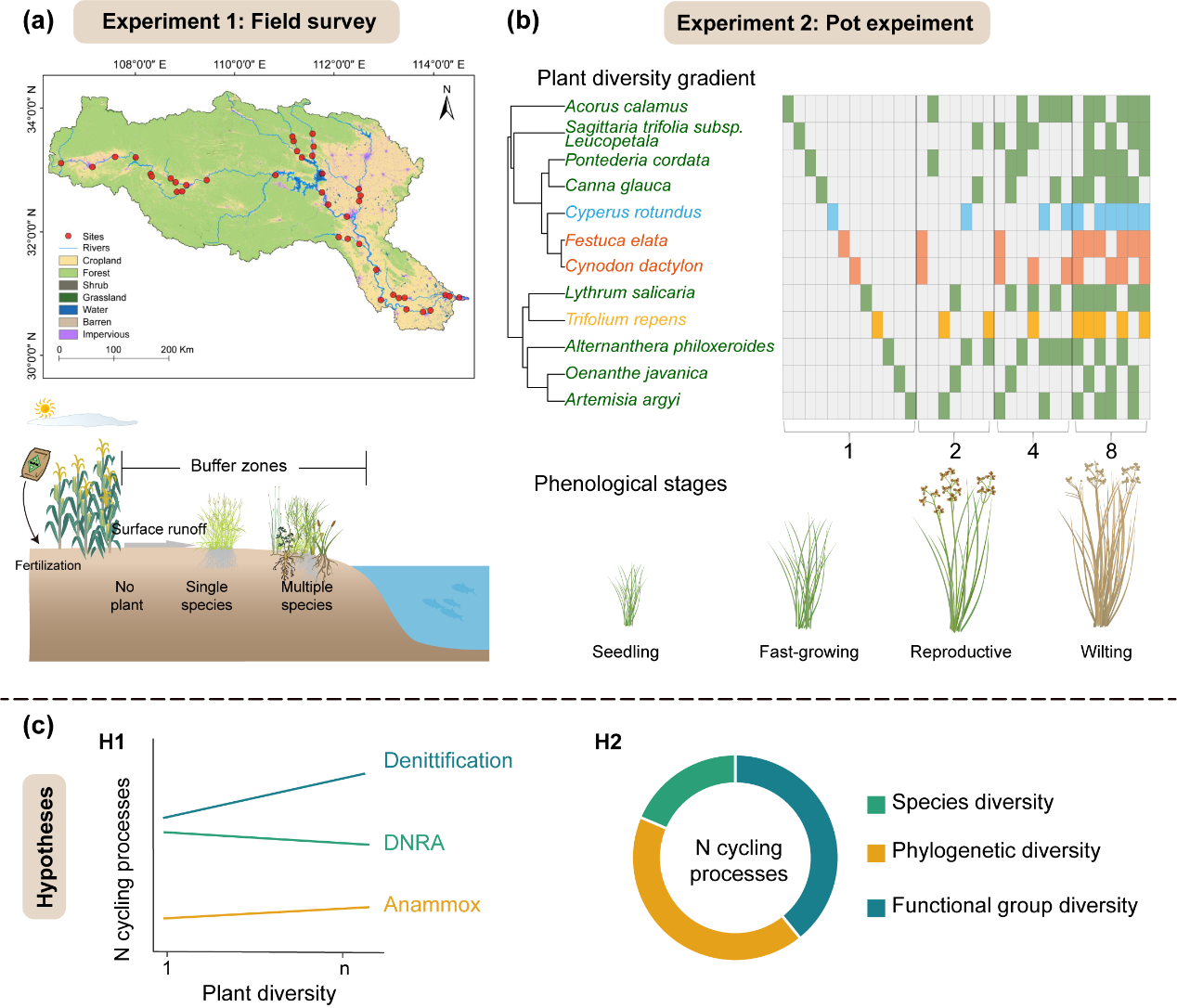
Graphical illustration of the framework and hypotheses of this study. A field survey was conducted across 41 riparian sites along the Hanjiang River (a), and a pot experiment was performed using 132 pots across four plant phenological stages (b). (Image by WBG)
<関連情報>
- https://english.cas.cn/newsroom/research_news/life/202509/t20250919_1055065.shtml
- https://nph.onlinelibrary.wiley.com/doi/10.1111/nph.70491
植物の多様性は湿地における土壌窒素の保持と除去プロセスを促進する Plant diversity promotes soil nitrogen retention and removal processes in wetlands
Caifang Zhang, Miaomiao Cai, Caroline Njambi Ndungu, Lin Ma, Wenzhi Liu
New Phytologist Published: 20 August 2025
DOI:https://doi.org/10.1111/nph.70491
Summary
- Although nitrogen (N) cycling processes are fundamental to the functioning of wetland ecosystems, the effects and underlying mechanisms of plant diversity on soil N cycling remain insufficiently understood.
- We conducted a field survey (123 soil samples) and a pot experiment (528 soil samples) to examine how multidimensional plant diversity (species diversity, phylogenetic diversity, and functional group diversity) affects key N cycling processes in wetland soils across different phenological stages (seedling, fast-growing, reproductive, and wilting).
- The results showed that multidimensional plant diversity was positively correlated with dissimilatory nitrate reduction to ammonium (DNRA), a N retention process, and denitrification, a N removal process, with greater effects on denitrification. Among the diversity metrics, phylogenetic diversity explained more variance in denitrification than species or functional group diversity, a pattern not observed for DNRA. Additionally, both plant diversity and phenological stages influenced soil N cycling processes directly or indirectly through their effects on soil dissolved organic carbon and functional gene abundances.
- Together, these findings highlight the critical role of plant diversity in regulating soil N cycling and offer a mechanistic understanding that can be incorporated into Earth system models to improve predictions of soil N dynamics in response to biodiversity change.